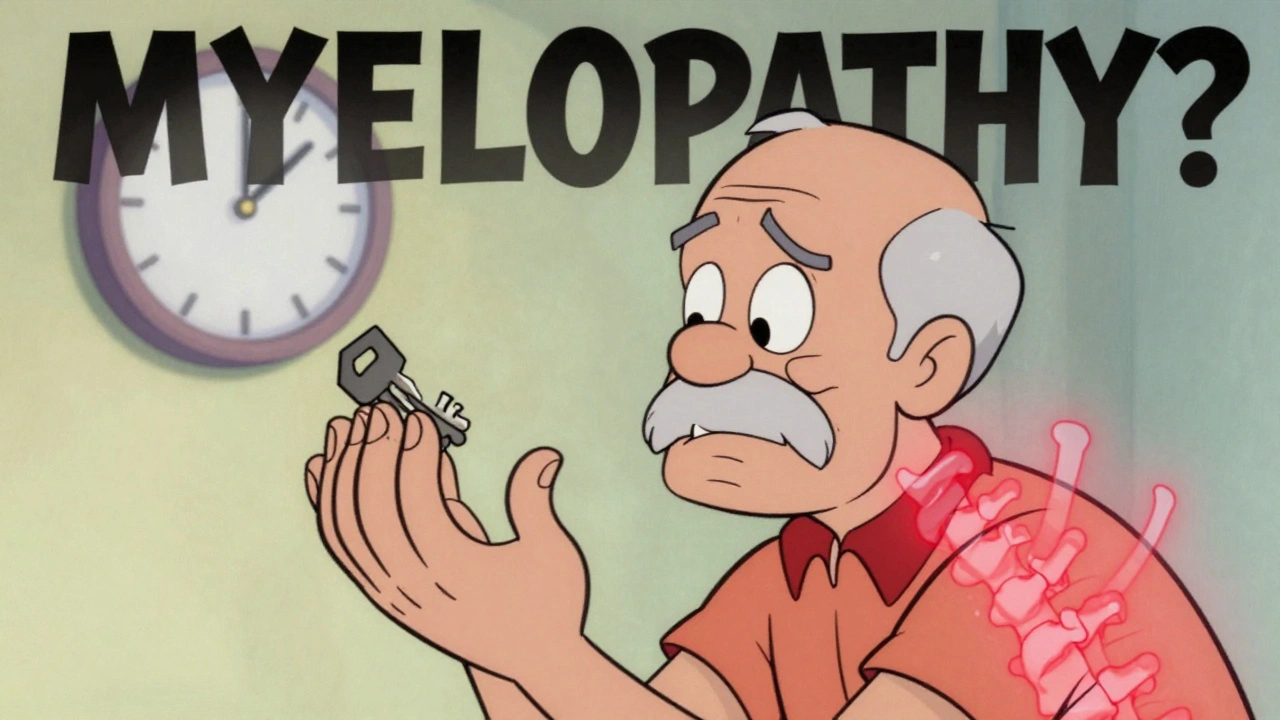
When your hands feel clumsy, your balance starts to slip, or you suddenly drop things you’ve held for years without trouble, it’s easy to blame aging. But these could be warning signs of something more serious: cervical myelopathy. This isn’t just a stiff neck or a pinched nerve. It’s spinal cord damage caused by narrowing in your neck - a condition called cervical spinal stenosis. Left unchecked, it can lead to permanent weakness, loss of coordination, and even paralysis. The good news? If caught early, surgery can stop it in its tracks - and often restore function.
What Exactly Is Cervical Myelopathy?
Cervical myelopathy isn’t the same as spinal stenosis, though the two are closely linked. Spinal stenosis means the space around your spinal cord has gotten too narrow - usually because of age-related wear and tear. But myelopathy only happens when that narrowing actually squishes the spinal cord enough to cause nerve damage. Think of it this way: stenosis is the narrowing. Myelopathy is the injury that results. Most cases - about 75% - are called cervical spondylotic myelopathy (CSM). This form develops slowly over years as discs dry out, bones grow spurs, and ligaments thicken. By age 70, nearly 1 in 10 people show signs of it on MRI scans. But not everyone has symptoms. The real danger is when the cord starts to get damaged. Once that happens, the clock starts ticking.Early Symptoms You Can’t Ignore
The first signs are subtle. You might think you’re just getting older. But here’s what to watch for:- Hand clumsiness - buttons, keys, or pens slip out of your fingers more often
- Walking feels unsteady, like you’re on a boat
- Numbness or tingling in your arms or hands
- Weakness when lifting objects or opening jars
- Increased reflexes in your knees or ankles (something a doctor checks with a reflex hammer)
- Difficulty with fine motor tasks like writing or typing
How Is It Diagnosed?
A doctor can’t diagnose this with just a physical exam or an X-ray. You need an MRI. That’s the gold standard. It shows exactly where the spinal cord is being squeezed and whether there’s already damage inside the cord itself - seen as bright spots on T2-weighted images. X-rays can show bone spurs or disc space narrowing, but they miss the soft tissue damage. CT scans with contrast (myelography) are used if you can’t have an MRI, but they’re less detailed. Electromyography (EMG) and nerve tests can catch early nerve dysfunction even before symptoms get bad. Doctors often use the Japanese Orthopaedic Association (JOA) score to measure severity. It rates your movement, sensation, and bladder control on a scale of 0 to 17. A score below 14 usually means you have myelopathy. A score under 12 is considered moderate to severe - and that’s when surgery becomes the clear recommendation.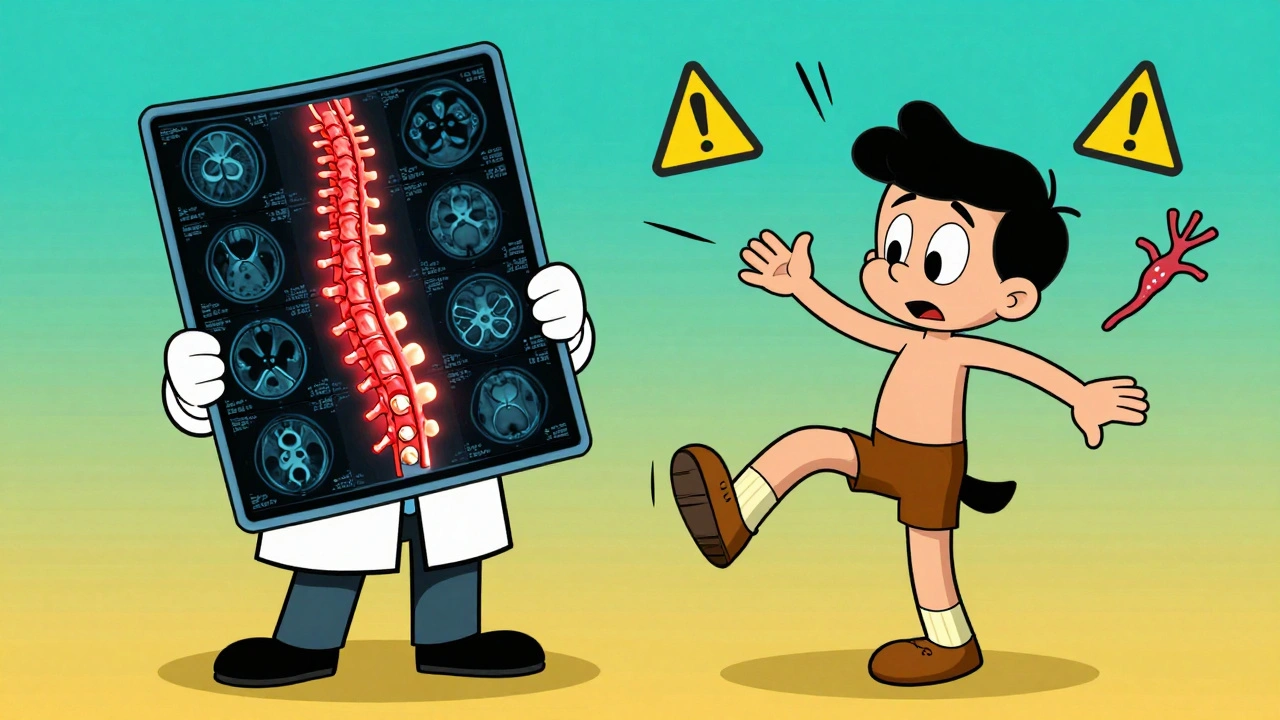
When Is Surgery Necessary?
Conservative treatment - like physical therapy, NSAIDs, or activity changes - might help if your symptoms are mild and stable. But here’s the hard truth: only about 28% of people with mild myelopathy improve over two years without surgery. The rest get worse. If your JOA score is below 12, or if your symptoms are getting worse even slowly, surgery is the best option. The American Academy of Orthopaedic Surgeons gives this a strong, evidence-backed recommendation (Grade A). Studies show 70-85% of patients improve after surgery - meaning they regain strength, balance, and hand function. Delaying surgery hurts your chances. People who operate within six months of symptoms starting recover 37% better than those who wait over a year. Every month you wait, your chance of full recovery drops by about 3%.Types of Surgery: What’s Right for You?
There are three main surgical approaches, and the best one depends on where the compression is, how many levels are affected, and your spine’s natural curve.- Anterior Cervical Discectomy and Fusion (ACDF): This is the most common for one or two levels. The surgeon removes the damaged disc and bone spurs from the front of your neck, then fuses the vertebrae with a bone graft and plate. Success rates are high - 85-90% of patients report improved function. But there’s a 5-7% risk of needing another surgery nearby within 10 years.
- Cervical Disc Arthroplasty (Artificial Disc): Similar to ACDF, but instead of fusing, they replace the disc with an artificial one. This keeps your neck moving. The FDA approved a new device for two-level use in 2023, with 81% success at preserving motion after two years.
- Posterior Approaches (Laminectomy, Laminoplasty): Used for three or more levels, or if your spine is straight instead of curved. Laminectomy removes the back part of the vertebrae. Laminoplasty opens the back like a door, giving more space without fusing. Laminoplasty causes less neck pain afterward but has slightly lower neurological recovery rates than fusion.
What to Expect After Surgery
Most people go home in 1-3 days. Recovery takes time. You’ll need physical therapy for 8-12 weeks. Focus is on gait training, balance, and strengthening your neck muscles. About 82% of patients report better hand function after a year. But only 65% regain normal walking ability. Nearly 30% still need a cane or walker. That’s not failure - it’s progress. Many patients go from needing help to walk to walking independently. Common side effects include temporary trouble swallowing (22% in the first few months), neck pain (35% after ACDF), and “post-laminectomy syndrome” - chronic neck pain after posterior surgery (18%). These usually improve, but not always.
Who Shouldn’t Have Surgery?
Surgery isn’t for everyone. People with severe heart disease, uncontrolled diabetes, or those who smoke are at higher risk for complications. Smoking alone increases the chance of failed fusion by 50%. Diabetics with HbA1c over 7% have twice the infection risk. Some patients have mild symptoms and stable scans. In those cases, watchful waiting with regular checkups may be better than jumping into surgery. But if your symptoms are worsening - even slowly - don’t wait. The natural history of untreated myelopathy shows 20-60% of people get significantly worse over two to five years. Only 10-15% get better on their own.What’s New in Treatment?
The field is changing fast. Minimally invasive techniques like tubular laminoplasty cut blood loss by 65% and reduce hospital stays by almost two days. Robotic-assisted surgery is coming - early data suggests it could cut revision rates from 10% to under 7% by improving precision. Researchers are also testing drugs like riluzole, used in ALS, to protect nerves during surgery. Early trials show patients who get the drug along with surgery improve 12% more on functional scores after six months. But there’s a warning. Surgeons are doing 33% more cervical operations now than in 2010. Yet patient selection hasn’t kept up. Experts estimate 15-20% of these surgeries might be unnecessary. That’s why accurate diagnosis - with MRI and clinical symptoms matching - is more important than ever.Final Thoughts: Don’t Wait Until It’s Too Late
Cervical myelopathy doesn’t come with a siren. It creeps in with small, frustrating changes - dropped keys, stumbling on flat ground, fingers that won’t cooperate. If you’re over 55 and noticing these, get checked. Don’t assume it’s just aging. See a spine specialist. Get an MRI. Don’t wait for pain. The damage happens before pain starts. Surgery isn’t a cure-all. But for most people with moderate to severe myelopathy, it’s the only way to stop the decline - and often, to get your life back.Can cervical myelopathy be reversed without surgery?
In mild cases with no progression, symptoms may stabilize with physical therapy and lifestyle changes. But true neurological damage from spinal cord compression rarely reverses without surgery. Studies show only 28% of patients improve without surgery over two years, while 63% get worse. Surgery remains the only proven way to halt progression and restore function in moderate to severe cases.
How long does recovery take after cervical myelopathy surgery?
Most patients are walking within a day or two after surgery. Full recovery takes 3 to 6 months. You’ll need formal physical therapy for 8 to 12 weeks, focusing on balance, strength, and coordination. Hand function often improves within 3 months, but gait stability can take longer - up to a year. Some people still need assistive devices, but most regain significant independence.
What are the risks of cervical spine surgery?
Major complications occur in 4-6% of cases. These include infection, bleeding, C5 nerve palsy (causing shoulder weakness), and difficulty swallowing. There’s a 1-2% risk of worsening neurological function. ACDF carries a 5-7% chance of needing another surgery nearby within 10 years due to adjacent segment disease. The risk is higher in smokers, diabetics, and those with poor bone quality.
Is an artificial disc better than fusion?
For single or double-level disease, artificial discs preserve motion and reduce long-term stress on nearby discs. They have similar success rates to fusion - around 85% - but with less neck pain and faster return to activity. However, they’re not ideal for patients with severe arthritis, instability, or more than two affected levels. Fusion is still the gold standard for complex or multi-level cases.
Why do some people still have pain after surgery?
Surgery relieves pressure on the spinal cord, but it doesn’t fix all damage. Some nerve injury is permanent. Post-surgery neck pain can come from muscle strain, scar tissue, or changes in spinal mechanics. About 35% of ACDF patients report persistent neck pain at six months. This usually improves with time and physical therapy, but not always. Laminectomy patients may develop chronic axial pain - known as post-laminectomy syndrome - in about 18% of cases.
Can I prevent cervical myelopathy?
You can’t stop age-related degeneration, but you can slow it. Avoid smoking - it accelerates disc dehydration. Maintain good posture and neck strength with regular exercise. Keep your weight in a healthy range to reduce spinal stress. If you have arthritis or disc degeneration, early monitoring with MRI can catch myelopathy before symptoms start. Prevention is about early detection, not avoiding aging.