Every year, millions of Americans wake up to medical bills they never agreed to pay - bills that show up on credit reports, lead to wage garnishments, or force them to choose between medicine and rent. In 2022, 74.6 million people carried medical debt, according to the Kaiser Family Foundation. By 2023, that number had grown to 100 million, with total medical debt hitting $195 billion, as reported by the Consumer Financial Protection Bureau. These aren’t just numbers. They’re real people, often stuck because the system let them down.
What Changed in New York in 2024?
In October 2024, New York State rolled out three new laws designed to stop healthcare providers from exploiting patients during their most vulnerable moments. These aren’t vague guidelines. They’re enforceable rules with real penalties - $2,000 per violation for some, up to $5,000 for others.
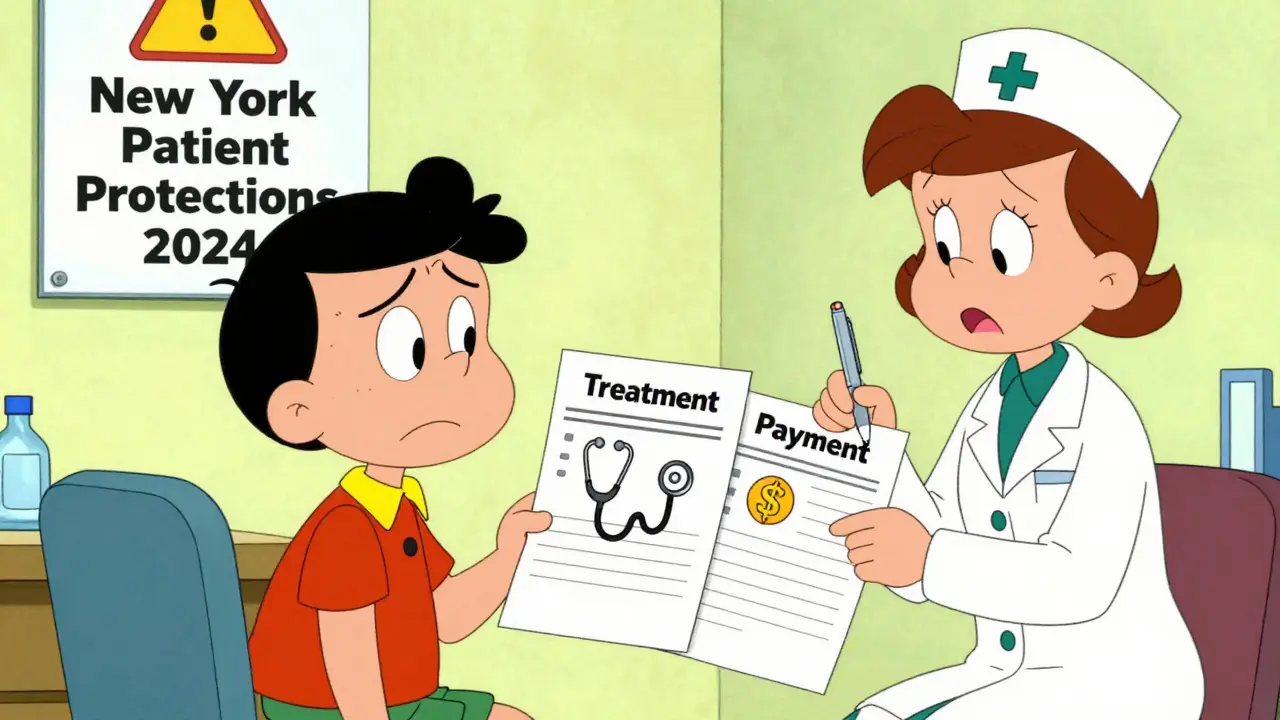
The biggest shift? Separate consent for treatment and payment. Before, patients signed one form at check-in - a single signature that gave providers permission to treat them and to charge them, often without clear explanation. Now, under Public Health Law Section 18-c, providers must get two separate signatures: one for medical care, one for financial arrangements. This means you can’t be pressured into agreeing to a payment plan while you’re still in the exam room, confused from pain or medication.
But here’s the catch: as of August 2025, enforcement of Section 18-c has been suspended. That doesn’t mean the law is gone - it means providers are in legal limbo. Some are still following it. Others aren’t. If you’re in New York, assume it’s still in effect until you hear otherwise from the state.
You Can’t Fill Out My Financial Applications - Not Even a Little
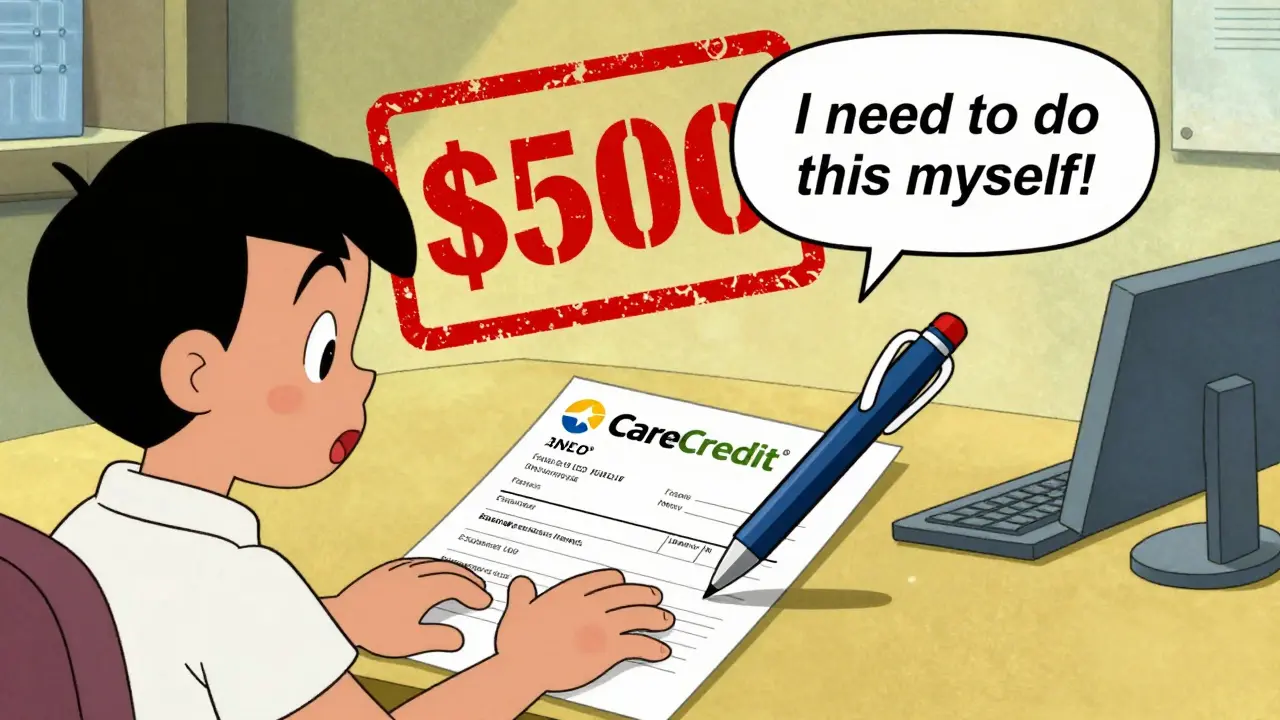
General Business Law Section 349-g makes it illegal for doctors, nurses, or billing staff to complete any part of your application for medical financing - even if you ask them to. That includes CareCredit®, CareLending, or any other healthcare-specific credit product.
Staff can answer your questions. They can hand you the form. They can explain what the options are. But they can’t fill in your name, income, or signature. If they do, they risk a $5,000 fine per violation. This law was written because too many patients were being steered into high-interest loans without realizing it. One patient told a reporter she didn’t know she’d signed up for a 24% interest loan until she got her first bill - and the provider had already filled out half the form.
No More Credit Card Preauthorization for Emergencies
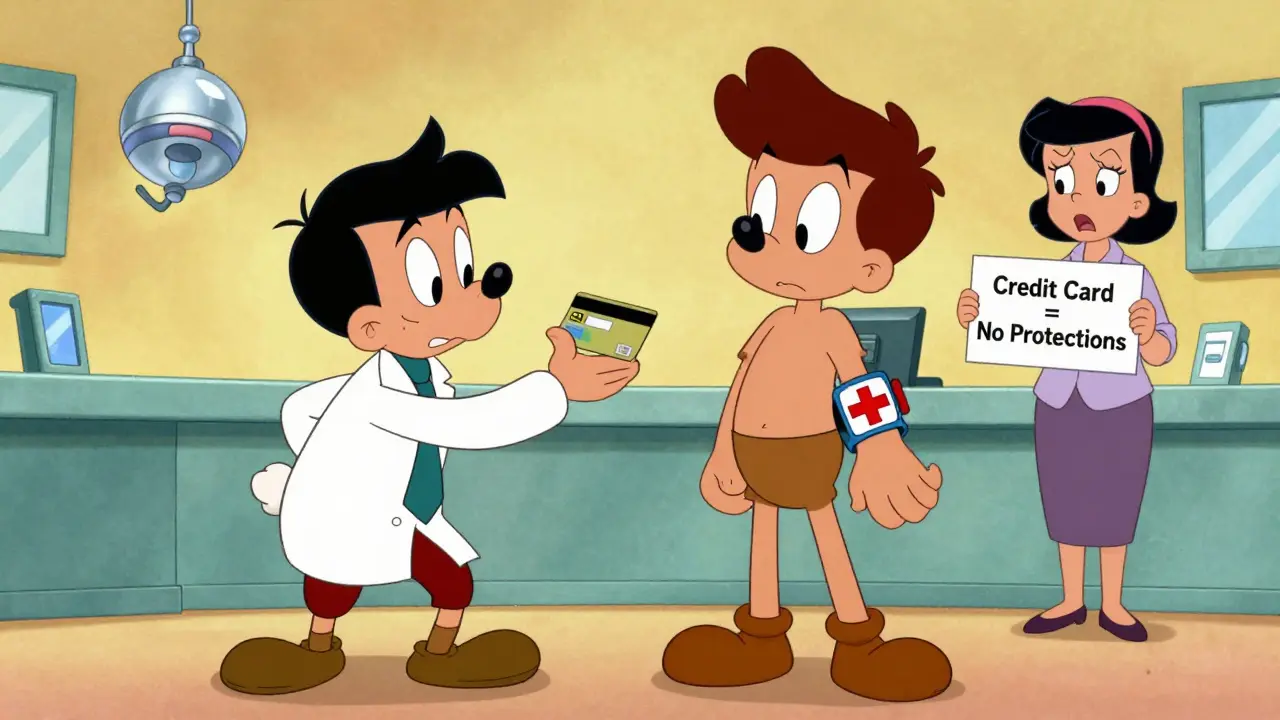
General Business Law Section 519-a is one of the most powerful protections. It says: no provider can require you to hand over your credit card before giving you emergency or medically necessary care. No more holding your treatment hostage until you swipe your card. No more keeping your card on file without your written permission.
And if you do pay with a regular credit card - not a healthcare financing product - the provider must warn you in writing that you’re losing key protections. Here’s why that matters: if you use CareCredit®, you’re protected under New York’s medical debt rules. Your debt can’t be sent to collections as easily. Your wages can’t be garnished. Your home can’t be liened. But if you pay with a Visa or Mastercard? Those protections vanish. You’re treated like any other consumer debt - and that’s dangerous.
How This Compares to Federal Laws
The federal No Surprises Act, which took effect in January 2022, stops surprise bills from out-of-network providers. That’s huge - but it doesn’t cover what happens inside your doctor’s office. New York’s laws go further. They target in-network billing practices, consent manipulation, and predatory financing.
Also, HIPAA protects your medical records. The No Surprises Act stops surprise bills. But neither stops a provider from pressuring you into a high-interest loan or forcing you to hand over your credit card before you’re seen. New York’s laws plug those gaps.
And then there’s the CFPB’s 2024 rule: medical debt can no longer appear on your credit report. That’s a win - but only if the debt is properly classified. If you used a regular credit card to pay for surgery, and that debt goes to collections, it might still show up. New York’s laws help ensure medical debt stays in its own category - where it belongs.
What This Means for You as a Patient
If you’re in New York, here’s what you should do:
- Always ask: "Is this consent for treatment or payment?" If they hand you one form, ask for two.
- If someone offers to help you fill out a CareCredit® application, say: "I need to do this myself." They’re not allowed to help.
- If you’re asked to give your credit card before an emergency procedure, say: "I’m not required to do that under state law." If they insist, ask for a supervisor or file a complaint with the New York State Department of Health.
- If you pay with a regular credit card, demand a written warning about the risks. If they refuse, report them.
These laws exist because patients were being taken advantage of - not by bad actors alone, but by systems designed to profit from confusion. You have rights. Know them.
What Providers Are Doing to Adapt
Hospitals and clinics are scrambling. Staff training is mandatory. Forms are being redesigned. Some offices have hired compliance officers just to handle these new rules. But many are still confused - especially with Section 18-c suspended. Some are waiting for clarification. Others are moving forward anyway, fearing future penalties.
GoldSand Friedberg, a legal advisory firm, recommends providers keep detailed records of every patient interaction involving payment consent. Why? Because if you’re audited, you need to prove you didn’t violate the rules. That means saving signed forms, training logs, and even timestamps of when patients were given disclosures.
It’s expensive. It’s complicated. But it’s necessary.
Is This Trend Spreading?
Yes. New York isn’t alone. California, Illinois, and Colorado have introduced similar bills in 2025. The CFPB’s move to remove medical debt from credit reports has opened the door. States are watching. And patients are speaking up.
Barclays Health Law Advisory predicted in late 2024 that at least five more states will adopt New York-style laws by 2027. The momentum is real. Medical debt is no longer seen as a personal failure - it’s recognized as a systemic flaw.
What Happens If You’re Not in New York?
Even if you live outside New York, these laws matter. They set a new standard. If your provider asks you to sign one form for everything, push back. If they offer to help you apply for CareCredit®, politely refuse. If they demand your credit card before treatment, say no - and ask why.
These protections aren’t just for New Yorkers. They’re a blueprint. And you don’t need to wait for your state to catch up. You can start exercising these rights today.
Final Reminder: Know Your Rights
You have the right to:
- Understand exactly what you’re agreeing to - in plain language.
- Refuse to sign a combined consent form.
- Complete your own medical financing applications - no help allowed.
- Pay for emergency care without handing over your credit card.
- Be told the risks of using a regular credit card for medical bills.
Medical care should never come with hidden financial traps. These laws are a step toward fairness. But they only work if you know them - and use them.
Do these New York patient protection laws apply to me if I’m not a resident?
If you receive medical care in New York, these laws apply to you - regardless of where you live. The protections are tied to where the service is provided, not where you’re from. So if you’re visiting New York and need emergency care, the provider must follow these rules. The same applies if you’re a student, worker, or traveler getting treated in the state.
What’s the difference between CareCredit® and a regular credit card for medical bills?
CareCredit® and similar healthcare financing products are designed specifically for medical expenses. If you use them, you’re covered under New York’s medical debt protections - meaning your debt can’t be reported to credit bureaus as easily, wage garnishment is restricted, and liens on your home are blocked. A regular credit card? Those protections vanish. The debt is treated like any other consumer debt, which means it’s easier to send to collections and harder to dispute.
Can a provider refuse to treat me if I don’t sign a payment consent form?
No. Under New York law, providers cannot deny emergency or medically necessary treatment because you refuse to sign a payment consent form. Treatment and payment consents are separate. You can receive care without agreeing to a payment plan on the spot. If they threaten to turn you away, ask to speak to the compliance officer or file a complaint with the state.
What should I do if a provider filled out my CareCredit® application for me?
Call the provider immediately and demand the application be canceled. Then file a complaint with the New York State Department of Health and the Consumer Financial Protection Bureau. This is a clear violation of General Business Law Section 349-g, and providers can be fined up to $5,000 per incident. Keep a record of your communication.
Are these laws permanent, or could they be rolled back?
Most of these laws are written into state statutes and can only be changed by the legislature. While Section 18-c’s enforcement is currently suspended, the law itself hasn’t been repealed. Experts believe the broader protections - especially around credit card disclosures and application interference - are here to stay. They align with national trends and consumer demand for transparency. Any rollback would face strong public and legal pushback.