Drug Withdrawal Timeline Calculator
Withdrawal Timeline Comparison
Compare historical withdrawal timelines to the new 2023 FDA process
Under the 2023 legislation, the FDA must:
- Notify company within 30 days
- Allow 60 days for response
- Make final decision within 180 days
Key change: Average withdrawal time reduced from 46 months to under 6 months
Historical Timeline
Historical: 46 months
Current: 6 months
Average withdrawal time before 2023 legislation
Current Timeline
Historical: 46 months
Current: 6 months
Under 2023 legislation (180 days max)
Potential Impact:
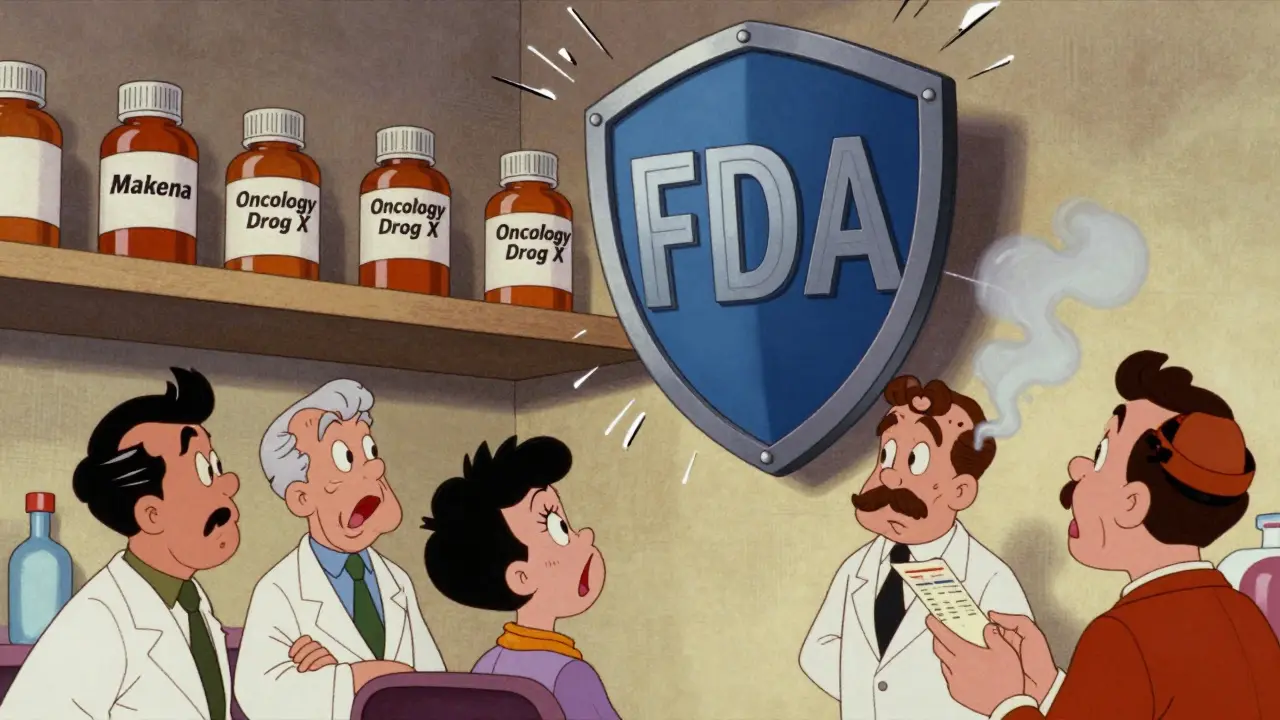
Example: The Makena drug (approved 2011, withdrawn 2022) affected 150,000 patients over 11 years before withdrawal. Under new rules, withdrawal would have occurred within 6 months.
Every year, drugs that once seemed like breakthroughs disappear from pharmacy shelves. No warning. No fanfare. Just a quiet removal from the market, leaving doctors, pharmacists, and patients scrambling to understand why. This isn’t a glitch. It’s a system designed to protect people - but for decades, it moved too slowly. Today, changes are finally forcing faster action when drugs fail.
Drug withdrawals and recalls aren’t the same thing. A recall usually means a batch of pills has a manufacturing flaw - maybe a mislabeled bottle or a contaminated container. A withdrawal is deeper. It means the drug itself, as a whole, no longer meets the basic standard: it doesn’t work as promised, or it’s unsafe. The FDA doesn’t remove drugs lightly. But when evidence piles up, they have to act - even if it takes years.
In the past, the timeline between proof a drug doesn’t work and its removal could stretch longer than the time it took to approve it. Take Makena is a synthetic hormone approved in 2011 to prevent preterm birth in high-risk women. The approval was based on a small study using a surrogate marker - not actual birth outcomes. By 2020, a large follow-up trial proved it didn’t reduce preterm births. But it took the FDA another two years to pull it. During that time, over 150,000 women received a drug that offered no benefit. That’s not just a failure. It’s a risk.
The problem wasn’t just Makena. Between 2010 and 2020, about 1 in 8 drugs approved through the FDA’s accelerated pathway - meant to speed up treatments for serious illnesses - were later withdrawn. Oncology drugs led the list. In one case involving small cell lung cancer, 41% of eligible patients were treated with a drug that was later pulled for lack of effectiveness. Patients weren’t told. Prescribers weren’t warned. The system didn’t flag it.
This is where the Consolidated Appropriations Act of 2023 is a major legislative shift that gave the FDA new power to remove drugs faster. Before, the FDA could only request studies after approval. If a company didn’t do them, or if the studies failed, the agency had to go through a long legal process. Now, under Section 3210, the FDA can act if:
- The sponsor doesn’t conduct required post-approval studies with due diligence
- The confirmatory study fails to prove the drug works
- Independent evidence shows the drug is unsafe or ineffective
- The company promotes false or misleading claims about the drug
The process now has deadlines. The FDA must notify the company within 30 days of proposing withdrawal. The company gets a chance to respond and meet with FDA officials within 60 days. A final decision must come within 180 days. That’s a drastic change from the old average of 46 months.
The
Orange Book is the FDA’s official list of approved drug products with therapeutic equivalence evaluations. It’s not just a directory. It’s a legal tool. When a drug is withdrawn for safety or effectiveness reasons, the FDA updates the Orange Book. This matters because generic drug makers need to reference an approved drug to get their own versions to market. If the reference drug is withdrawn, it can block generic competition - even if the generic is perfectly safe. That’s why the FDA now publishes monthly updates to the "Determination of Safety or Effectiveness" list. Pharmacists and insurers rely on this to decide what gets covered.
The shift isn’t just about speed. It’s about transparency. Before 2023, withdrawal notices were buried in legal jargon. Now, the FDA issues public notices in the Federal Register. They explain exactly why the drug was pulled. They list the evidence. They respond to public comments. This matters to patients. A 2022 survey found 63% of pharmacists still struggled to interpret Orange Book listings. Clearer communication helps.
For doctors, the challenge is real. When a drug is pulled, they have to switch patients. In oncology, where treatment windows are narrow, this isn’t simple. One study found oncology practices needed an average of 72 hours to develop alternative treatment plans after a withdrawal. That’s time patients don’t have. Some clinics now keep withdrawal contingency plans on file - just like they do for drug shortages.
Patient advocacy groups have been the loudest critics. In forums like Reddit’s r/oncology, hundreds of people shared stories: "I was on a drug for 18 months before the trial failed. My oncologist said it was standard care." The emotional toll is real. One patient advocacy survey found 78% believed the FDA takes too long to remove ineffective drugs. The 2023 law was hailed as a victory - especially by groups like the Cancer Research Institute, which called it "a crucial step toward protecting patients."
But there’s a flip side. Drug makers warn that faster withdrawals could chill innovation. Companies developing drugs for rare cancers or untreatable diseases need to take risks. If every early sign of failure triggers an immediate pull, fewer companies will try. The
Biotechnology Innovation Organization (BIO) has warned that overly aggressive withdrawal could hurt progress in high-risk areas. The FDA acknowledges this tension. Their goal isn’t to scare off innovation - it’s to stop putting patients on drugs that don’t work.
The first drug pulled under the new 2023 rules was an ALS treatment in August 2023. The FDA moved in under 120 days. That’s a signal. They’re not just changing the rules. They’re changing their culture.
Looking ahead, the FDA is testing new tools. In January 2024, they launched a pilot using real-world data from Flatiron Health - actual patient records from clinics - to monitor whether drugs work after approval. This could mean fewer years of waiting for confirmatory trials. If a drug shows no benefit in real-world use, the FDA might act before the formal trial even ends.
The future of drug safety isn’t about perfect approval. It’s about faster correction. Drugs will still be approved with uncertainty. That’s part of treating serious illness. But the days of letting ineffective drugs sit on shelves for years while patients keep taking them? Those are ending.
The system still has gaps. Not all withdrawn drugs are flagged clearly in electronic health records. Not all insurers update coverage fast enough. And not every doctor knows the Orange Book changes. But the tools are there now. The FDA has the authority. The process has deadlines. The public is watching.
This isn’t about blame. It’s about balance. Science moves fast. Regulation has to keep up. And when the evidence says a drug doesn’t work - no matter how promising it once seemed - the right thing to do is remove it. Fast.