If your eyelids feel gritty, crusty in the morning, or constantly red and irritated, you’re not alone. About blepharitis affects nearly half of all people who visit an eye care professional. It’s not rare. It’s not dangerous to your vision. But it’s persistent, annoying, and often misunderstood.
What Blepharitis Really Feels Like
Blepharitis isn’t just dry eyes. It’s inflammation right along the edge of your eyelids - where your lashes grow. You’ll notice flakes like dandruff stuck to your lashes, your eyes burn or sting, and in the morning, your lids might feel glued shut. That’s because overnight, oily secretions from your eyelid glands thicken, dry out, and form crusts.
There are two types. Anterior blepharitis hits the outside edge of the lid, near the lashes. Posterior blepharitis - which is more common - affects the inner edge, where tiny oil glands (called meibomian glands) sit. When these glands get clogged, your tears evaporate too fast, leaving your eyes dry and irritated. About 63% of blepharitis cases are posterior. And if you’ve had this for years, you might even notice lashes falling out or growing crooked.
Doctors use a slit-lamp to see it clearly. You’ll spot collarettes - little rings of debris around your lashes - or visible blood vessels along the lid edge. It’s not contagious. It won’t blind you. But left alone, it just keeps coming back.
Why Warm Compresses Are the First Thing You Should Do
Every major eye health group - the National Eye Institute, Mayo Clinic, American Academy of Ophthalmology - agrees on one thing: warm compresses are step one. No pills. No drops. Just heat.
Here’s why it works: the oil in your meibomian glands thickens over time, like butter left in the fridge. Warmth melts it. At 40-45°C (104-113°F), the oil becomes liquid again and can flow out naturally. That’s the magic number. Too cold (under 38°C), and nothing happens. Too hot (over 48°C), and you risk burning your skin.
Studies show that doing this right reduces symptoms by 73% in the first few weeks. People who stick with it for 21 days see a 68% improvement in how well their glands work. The key isn’t just heat - it’s sustained heat. Most people use a washcloth, but it cools down too fast. On average, a warm washcloth stays hot enough for only 8.7 minutes. A microwavable gel pack lasts longer - about 12.3 minutes. That extra time matters.
How to Do It Right (Step by Step)
It’s not just about putting something warm on your eye. Technique makes all the difference.
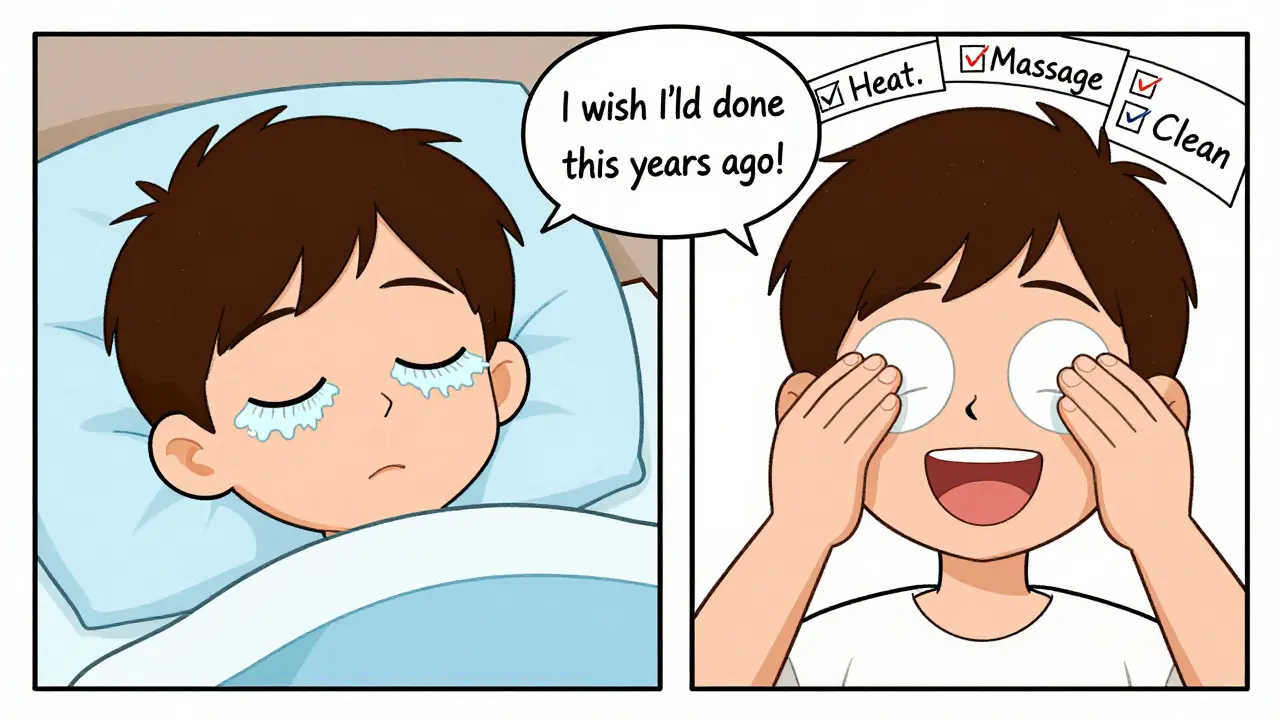
- Heat for 10 minutes - Use a clean washcloth soaked in warm (not hot) water, or a medical-grade gel pack. Keep it at 40-45°C. Reheat if it cools. Set a timer. Don’t guess.
- Massage immediately after - While your lids are still warm, use your clean fingertip. Gently rub your upper lid downward and your lower lid upward - like wiping a windshield. Do this for 30 seconds. This pushes the melted oil out of the glands.
- Clean the lid edge - Use a preservative-free lid scrub or a drop of baby shampoo on a cotton swab. Gently wipe the base of your lashes. Don’t scrub hard.
- Use artificial tears if needed - After cleaning, if your eyes still feel dry, use preservative-free drops. Avoid redness-relief drops - they make it worse long-term.
Do this twice a day - morning and night - for at least 30 days. Morning is most important because that’s when crusts build up overnight.

What People Get Wrong
Most people give up because they don’t see results fast. Or they do it wrong.
A study of 1,243 people on the American Academy of Ophthalmology’s patient forum found that 68% felt much better with consistent use. But 22% only saw moderate improvement - and 10% felt no difference. Why? Three reasons:
- They didn’t keep the heat warm long enough (62% of beginners underheat)
- They skipped the massage (most people forget this step)
- They stopped after a few days (only 22% of inconsistent users saw improvement vs. 67% who stuck with it)
On Reddit’s r/EyeHealth, 81% of people who failed at first succeeded after getting proper instruction from a doctor or nurse. That’s huge. You don’t need fancy gear - just the right technique.
Do You Need a Fancy Device?
There are devices now - like the Bruder Moist Heat Eye Compress or the TearCare System - that hold exact temperature for 10-15 minutes. They cost $15-$40. People who use them are 27% more likely to keep doing it long-term. In one study, 73% of users kept going past 90 days, compared to just 46% with washcloths.
But here’s the truth: if you’re consistent with a washcloth and a timer, you’ll get the same results. The device helps with convenience, not effectiveness. A 2023 study in JAMA Ophthalmology found that properly used traditional compresses worked just as well as expensive ones - if you followed the protocol.
That said, if you struggle to remember or keep the heat warm, a commercial mask might be worth the investment. Especially if you’re over 60 - blepharitis gets worse with age.
What Else Helps (Beyond Compresses)
Compresses alone fix most mild-to-moderate cases. But for stubborn cases, doctors often add other steps:
- Omega-3 supplements - Taking 2,000 mg of EPA/DHA daily improves oil quality. One 2023 study showed a 34% boost in treatment success when combined with compresses.
- Antibiotic ointments - Only if there’s bacterial overgrowth. Usually temporary.
- Lid scrubs - Use them daily after compresses. Look for preservative-free formulas.
Don’t rely on eye drops labeled for “redness relief.” They contain vasoconstrictors that can make inflammation worse over time. Stick to artificial tears without preservatives.
How Long Until You See Results?
Don’t expect overnight magic. Most people notice less crusting and grittiness by day 14. By day 30, 85% of those who followed the full routine report major improvement. It’s not a cure - it’s maintenance. Like brushing your teeth, you’ll need to keep doing it.
After 4-6 weeks, you can drop to once a day if symptoms are under control. But stop completely, and it’ll come back - usually within weeks. About 89% of people need ongoing care, according to the American Academy of Ophthalmology.
When to See a Doctor
You don’t need to rush to the eye doctor for every itch. But if:
- Your eyelids swell, hurt, or look infected (yellow pus, severe redness)
- You lose vision or feel light sensitivity
- You’ve tried warm compresses for 6 weeks with no change
Then go. You might need a deeper cleaning, a culture test, or a prescription. But 92% of eye clinics offer free technique demos. Ask for one.
Final Thought: It’s a Habit, Not a Fix
Blepharitis isn’t something you ‘beat.’ It’s something you manage - like high blood pressure or allergies. The good news? You control it with two minutes twice a day. No prescriptions. No expensive treatments. Just heat, massage, and clean lids.
One patient wrote on a health forum: ‘After three weeks of doing it right, my morning crusting went from ‘glued shut’ to just a few flakes. I wish I’d done this years ago.’
That’s the power of getting the basics right.
Can blepharitis cause permanent vision loss?
No, blepharitis itself does not cause permanent vision loss. It affects the eyelid margins, not the cornea or retina. However, if left untreated for years, chronic inflammation can lead to secondary problems like corneal irritation or abnormal eyelash growth, which may temporarily blur vision. These issues resolve with proper management. Always see a doctor if you notice changes in your sight.
Can I use a microwaveable potato sack instead of a gel pack?
A microwaveable potato sack can work if it’s designed for heat therapy and holds temperature well. But many household items - like rice socks or damp towels - cool too quickly. For reliable results, use a product tested to maintain 40-45°C for at least 10 minutes. If you use a DIY option, check the temperature with a thermometer before applying it to your eyelid.
Why do my eyes feel worse after using a warm compress?
If your eyes feel worse, you’re likely applying too much heat, pressing too hard during massage, or not cleaning afterward. Overheating (above 48°C) can burn the skin. Too much pressure can damage glands. Skipping the lid scrub lets debris sit on the lid. Try lowering the temperature, using lighter pressure, and always follow with a gentle cleanse. If it still hurts, stop and consult your eye care provider.
Is blepharitis caused by poor hygiene?
No. Blepharitis isn’t caused by being dirty. It’s linked to skin conditions like rosacea, seborrheic dermatitis, or bacterial overgrowth on the eyelid. Even people who wash their face daily can get it. The goal of eyelid hygiene isn’t to ‘clean’ the infection away - it’s to keep the oil glands flowing properly. It’s a mechanical fix, not a cleanliness issue.
Can children get blepharitis?
Yes. Children - especially those with eczema or dandruff - can develop anterior blepharitis. It’s less common than in adults but still occurs. Warm compresses and gentle lid cleaning are safe for kids. Always use lukewarm water and avoid harsh cleansers. If symptoms persist, consult a pediatric ophthalmologist.
Should I stop wearing contact lenses if I have blepharitis?
Yes - temporarily. Contact lenses can trap debris and bacteria against your eye, making irritation worse. Switch to glasses while you’re starting your warm compress routine. Once your symptoms improve for 2-4 weeks and your lids are consistently clean, you can try contacts again. Use daily disposables and clean your case regularly. If irritation returns, talk to your eye doctor about lens type or material.