
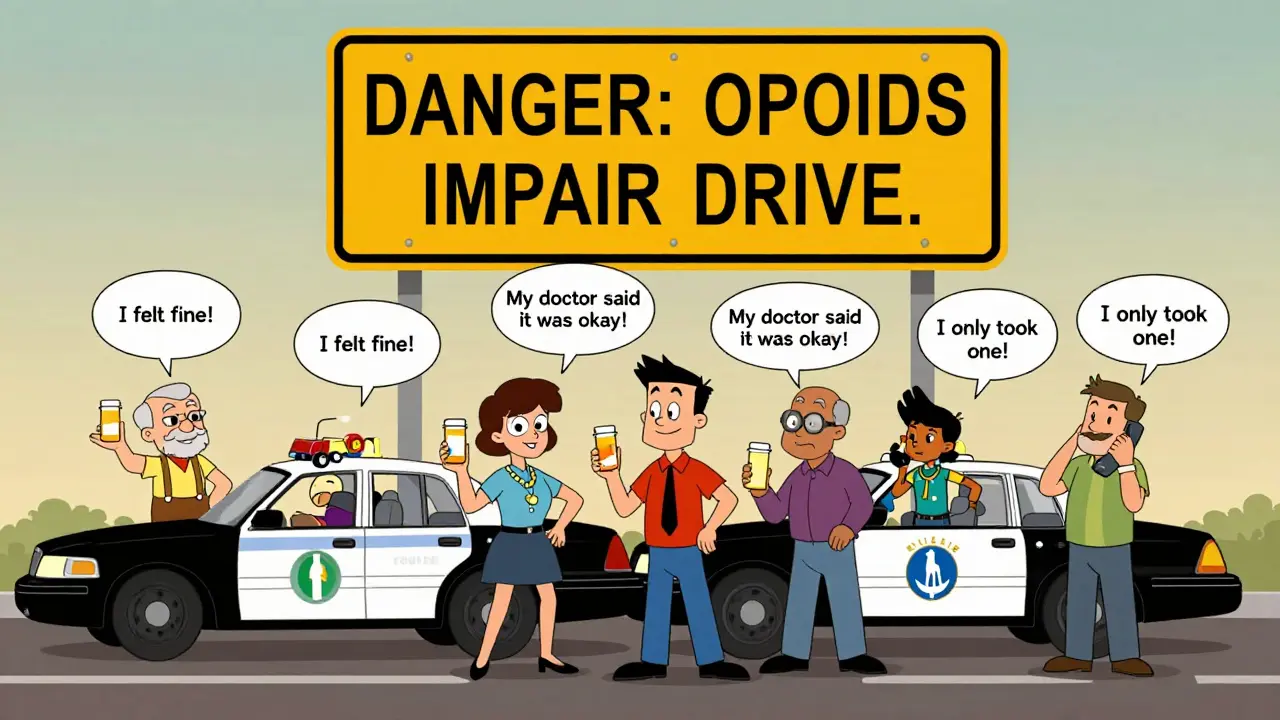
Driving on opioids isn’t just dangerous-it’s illegal in most places, even if your doctor prescribed it.
You take your opioid painkiller exactly as directed. No extra doses. No mixing with alcohol. You feel fine. So you hop in the car to run an errand. But here’s the truth: opioid impairment doesn’t always feel like being drunk. It doesn’t always make you slurred or unsteady. It makes you slow to react, fuzzy-headed, and less aware of what’s happening around you. And that’s enough to turn a routine drive into a life-altering crash.
In 2023, the National Highway Traffic Safety Administration found that nearly 44% of drivers killed in crashes who were tested for drugs had opioids in their system. That’s not just a number. That’s someone’s parent, sibling, or neighbor. And it’s happening because too many people think, “I’m on a prescription. It’s legal. I’m fine.” That’s a dangerous myth.
How opioids actually affect your driving
Opioids-whether it’s oxycodone, hydrocodone, fentanyl, or morphine-work by slowing down your central nervous system. That’s why they relieve pain. But that same effect also slows your brain’s ability to process information while driving.
Here’s what happens behind the wheel:
- Drowsiness: You might not fall asleep, but your reaction time drops. Studies show drivers on opioids are twice as likely to be in a crash.
- Reduced judgment: You misjudge distances, speeds, and gaps in traffic. A stoplight turns red, but your brain takes longer to register it.
- Impaired coordination: Steering becomes less precise. Braking feels delayed. Your hands don’t move as quickly as they should.
- Attention loss: You zone out. You miss road signs. You don’t notice a car braking ahead.
Dr. Richard Halpern from the National Safety Council says even a standard therapeutic dose of prescription opioids can impair you as much as a blood alcohol level of 0.05%-which is above the legal limit in the UK, Canada, and most of Europe. You don’t need to be “high” to be unsafe.
The law doesn’t care if it was prescribed
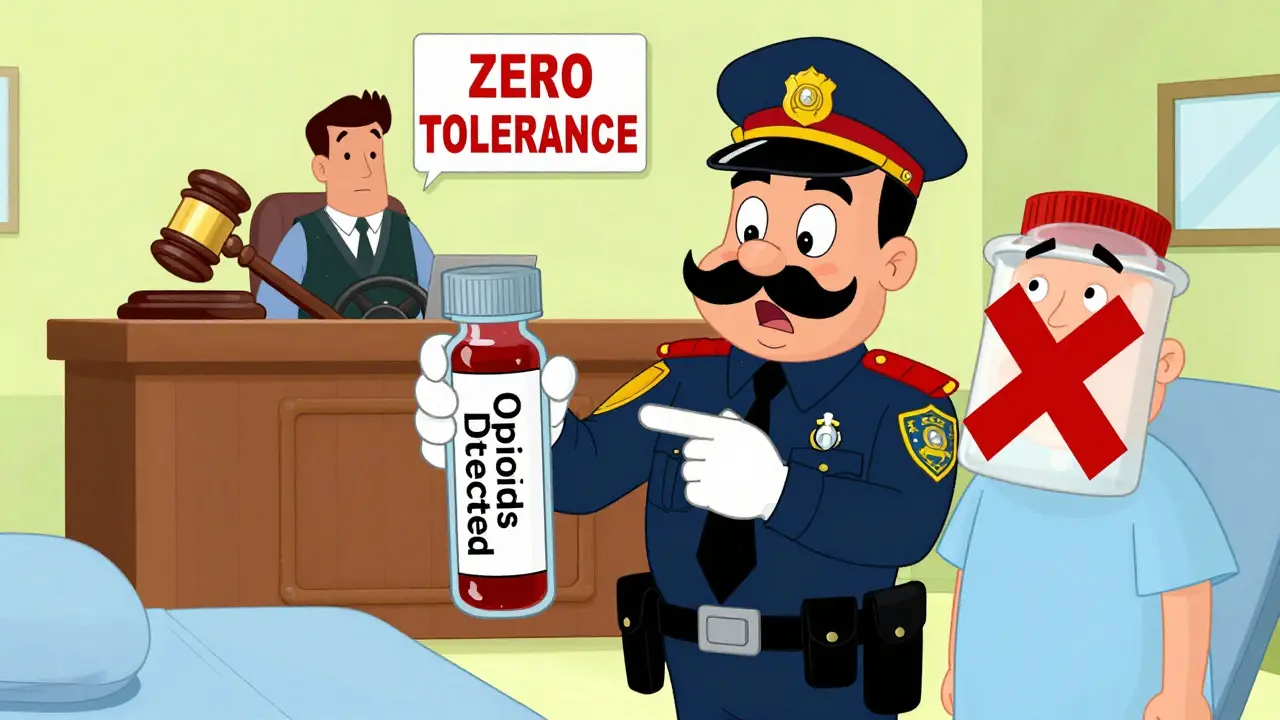
Here’s the part most people don’t realize: Having a prescription doesn’t protect you from a DUI.
In the United States, 16 states have zero-tolerance laws for opioids. That means if any amount of the drug is found in your blood-even if you took it exactly as directed-you can be charged with impaired driving. Five other states have per se laws, meaning specific levels of opioids in your system are automatically illegal, no proof of poor driving needed.
Canada treats opioid impairment exactly like alcohol impairment under its Criminal Code. If you’re caught driving while impaired by opioids, you face the same fines, license suspension, and possible jail time as someone who had a few beers.
And it’s not just the U.S. and Canada. In the UK, the law is clear: driving while impaired by any drug, legal or illegal, is a criminal offense. The police don’t need to prove you were “drunk.” They only need to show your driving was affected by the medication.
One Reddit user, u/PainPatient88, wrote: “My doctor said it was fine to drive on 5mg oxycodone twice daily. Then I failed a field sobriety test. Now I’m facing a DUI.” He wasn’t abusing his meds. He was following instructions. And it still cost him his license.
Why detection is so tricky-and why that makes it worse
Unlike alcohol, where a breathalyzer gives a clear 0.08% limit, opioids don’t have a universal “safe” or “unsafe” blood level. Why? Because everyone reacts differently. One person might be fine on 10mg of hydrocodone. Another might be dangerously impaired on 5mg.
Police use a two-step process: first, a Standardized Field Sobriety Test (like walking heel-to-toe or standing on one foot). If you fail, they call in a Drug Recognition Expert (DRE)-a specially trained officer who looks for signs like pinpoint pupils, slow speech, or abnormal eye movement. Then comes a blood or oral fluid test.
The problem? These tests can’t tell you when you took the drug or how much it’s affecting you right now. A person who took a dose 6 hours ago might still test positive, even if they’re no longer impaired. Someone who took a new dose 30 minutes ago might not show enough in their system yet to trigger a positive test-but they’re already unsafe behind the wheel.
This inconsistency is why some civil rights groups argue zero-tolerance laws are unfair. But the reality is: the risk is too high to wait for perfect science.
What patients don’t know (and what doctors often don’t tell them)
A 2022 survey by the Pain News Network found that 63% of people prescribed opioids didn’t know driving on them could lead to a DUI. Nearly 3 in 10 admitted they’d driven within an hour of taking their medication.
Why? Because many doctors don’t bring it up. The National Safety Council found that 72% of patients received little to no counseling about driving risks when they were given their prescription.
Pharmacists sometimes say, “It’s fine if you feel okay.” But that’s not enough. The warning labels on opioid bottles say “Do not operate heavy machinery.” That includes your car. The FDA required this warning to be added to all opioid packaging in 2020 as part of its Risk Evaluation and Mitigation Strategy (REMS).
One user on Drugs.com wrote: “My pharmacist told me it was fine to drive on hydrocodone. Now I have a DUI on my record.”
How to stay safe-and legal
If you’re on opioids, here’s what you need to do:
- Ask your doctor: “Will this affect my ability to drive? How long should I wait after taking it?” Don’t assume it’s safe.
- Check the label: If it says “may cause drowsiness” or “do not operate machinery,” take it seriously.
- Wait before driving: Mayo Clinic recommends waiting at least 3-4 hours after an immediate-release dose, and 6-8 hours after extended-release versions.
- Plan ahead: If you’re unsure, arrange a ride. Use a taxi, public transport, or ask a friend. It’s not weakness-it’s responsibility.
- Know your state’s laws: If you live in the U.S., check your state’s drug-impaired driving rules. Some allow a defense if you had a valid prescription. Others don’t.
California’s Office of Traffic Safety puts it simply: “Plan ahead for a sober driver if you plan to use an impairing drug.”
What’s changing-and what’s coming
Things are moving fast. In 2023, the FDA approved the Dräger DrugTest 5000, a handheld device that can detect fentanyl and other synthetic opioids in saliva within minutes. Forty-seven U.S. states now use these roadside tests, up from just 32 in 2020.
The National Highway Traffic Safety Administration has invested $15.7 million in 2023 alone to train more Drug Recognition Experts. By 2025, they aim to have 5,000 more on the road.
Employers are catching on too. UPS started requiring medical reviews for any employee prescribed opioids in 2021. Since then, medication-related incidents dropped by 37%.
But the biggest threat? Fentanyl. The DEA reports a 262% increase in fentanyl-related impaired driving cases between 2020 and 2023. This synthetic opioid is 50 to 100 times stronger than morphine. Even a tiny amount can shut down your breathing-and your reaction time.
It’s not about judgment. It’s about survival.
There’s no shame in needing pain relief. But there’s huge risk in assuming you’re safe to drive just because you’re following your prescription. Opioids don’t just dull pain-they dull your ability to stay alive behind the wheel.
If you’re taking them, treat your car like a weapon. Because, in the wrong hands, it is.
Don’t wait for a crash to learn the lesson. Don’t wait for a DUI to realize the truth. The safest choice isn’t always the easiest one-but it’s the only one that keeps you and everyone else alive.
Need help? Call SAMHSA’s national helpline: 1-800-662-4357. They fielded over 12,000 calls in 2022 from people just like you-wondering if it’s safe to drive on their meds.