Vitamin K Intake Calculator
This tool helps you calculate your daily vitamin K intake from common foods. The recommended daily intake for warfarin patients is 60-120 micrograms (µg) to maintain stable INR levels. Enter your daily consumption to see if you're within the ideal range.
Your Daily Vitamin K Intake
When you’re on warfarin, your life doesn’t revolve around pills-it revolves around food. Not because you need to avoid it, but because you need to eat it the same way, every day. That’s the real secret to keeping your INR in range and staying out of the hospital.
Why Your Plate Matters More Than Your Pill
Warfarin works by blocking vitamin K from helping your blood clot. That’s why it’s used for conditions like atrial fibrillation or deep vein clots. But vitamin K doesn’t just show up once in a while-it’s in your spinach, your broccoli, your kale, even your eggs. Every time you eat it, your body gets a signal to start making clotting factors again. And that directly fights what warfarin is trying to do.If you eat a big salad on Monday and then skip greens all week, your INR will swing like a pendulum. One day it’s too high-risk of bleeding. The next day it’s too low-risk of clotting. That’s not just inconvenient. It’s dangerous.
Research from Thrombosis and Haemostasis shows people with inconsistent vitamin K intake are 2.3 times more likely to have INR levels outside the safe range. That’s not a small risk. That’s the difference between managing your condition and ending up in the ER.
What’s the Right Amount of Vitamin K?
Forget the old advice to avoid green vegetables. That’s outdated-and harmful. The American College of Chest Physicians says outright: “Dietary vitamin K restriction is not recommended and may be harmful.” Why? Because cutting out vitamin K doesn’t stabilize your INR. It makes it worse.Here’s what actually works: aim for 60-120 micrograms (µg) of vitamin K every day. That’s not a lot. It’s about one cup of cooked spinach, or a big bowl of raw kale, spread across your week. You don’t need to eat it all at once. Just keep it steady.
The Recommended Dietary Allowance (RDA) is 90 µg for women and 120 µg for men. Most Americans already eat close to that. You don’t need to add more. You just need to stop letting it jump around.
Studies prove it. A 2015 Blood journal study gave unstable patients 150 µg of vitamin K daily. Their time in therapeutic range jumped from 58% to 66%. No extra bleeding. No extra clots. Just better control.
What Foods Are High in Vitamin K?
You don’t need to memorize a list. But you should know the big ones:- Raw kale: 547 µg per cup
- Cooked spinach: 889 µg per cup
- Cooked broccoli: 220 µg per cup
- Raw lettuce: 40-60 µg per cup
- Green peas: 40 µg per cup
- Eggs: 20 µg per large egg
- Chicken breast: 2 µg per 3 oz
- Whole milk: 1 µg per cup
Notice something? You don’t need to avoid these foods. You just need to pick a few and stick with them. If you like spinach, have it twice a week. If you prefer broccoli, eat it on Tuesdays and Fridays. Consistency beats variety here.
And don’t fall for the myth that all leafy greens are the same. A cup of raw spinach has almost twice the vitamin K of cooked. Cooking changes the density. That’s why measuring matters.
Why Measuring Beats Guessing
Most people estimate. They say, “I had a salad.” But what does that mean? A handful? A bowl? A plate piled high?A study in the Journal of the Academy of Nutrition and Dietetics found that visual estimation leads to 45% more variation in vitamin K intake than using measuring cups. That’s huge. It means your INR will bounce around just because you used a bigger spoon.
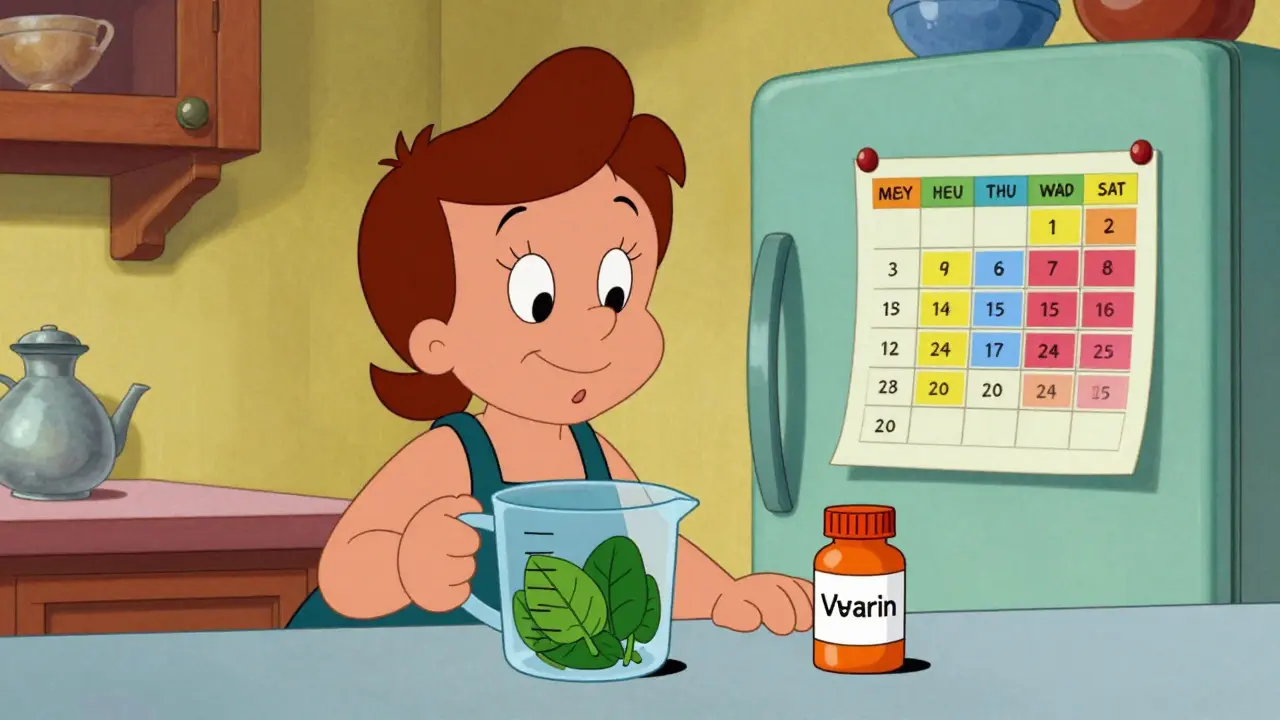
Here’s a simple trick: keep a small measuring cup in your kitchen. Use it for greens. One cup raw spinach = 547 µg. Half a cup cooked broccoli = 110 µg. One egg = 20 µg. Write it down for the first month. You don’t need to do it forever. Just until your body learns the rhythm.
Apps like Warframate have built-in databases with over 1,200 foods. You can scan barcodes or search by name. It tells you the vitamin K content and even tracks your weekly average. Many users report their INR stability jumped after just two weeks of using it.
What About Supplements and New Foods?
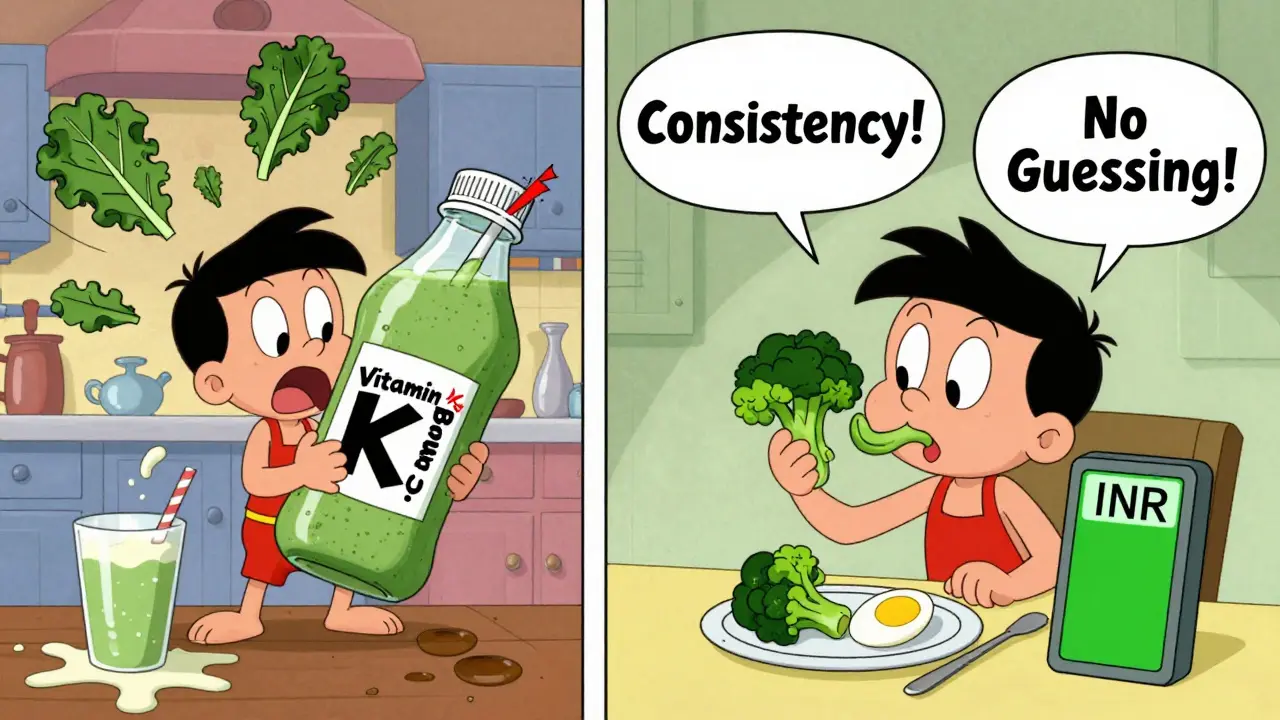
Don’t start taking vitamin K supplements unless your pharmacist or doctor tells you to. Even then, it’s usually only if your INR is all over the place and your diet is already consistent.And don’t suddenly add a new superfood. If you’ve never eaten kale, don’t start eating a whole bag of it one day. Same with wheatgrass juice, spirulina, or green smoothies. They’re packed with vitamin K. One glass can throw off your INR for days.
If you want to try something new, talk to your anticoagulation clinic first. They can help you adjust your warfarin dose safely. Don’t guess. Don’t wait for your next INR test to find out you messed up.
Genetics Play a Role Too
Not everyone reacts the same way to vitamin K. Some people have genetic variants in the VKORC1 or CYP2C9 genes that make them extra sensitive. If you’ve had trouble with warfarin since day one, even with a steady diet, you might be one of them.Studies show these people need even tighter control-keeping vitamin K intake within ±10% daily variation instead of ±20%. That’s harder, but doable. If your INR keeps drifting despite consistent eating, ask your doctor about genetic testing. It’s not routine, but it can explain why you’re struggling.
Real People, Real Results
Reddit user u/WarfarinWarrior posted: “My INR was all over the place until my pharmacist gave me a vitamin K tracking sheet. Now I eat exactly one cup of mixed greens every Tuesday and Thursday. My time in range jumped from 45% to 78%.”That’s not magic. That’s science. That’s consistency.
At the Mayo Clinic, patients who got personalized dietary counseling from anticoagulation pharmacists hit 82% time in therapeutic range. Those who didn’t? Only 63%. That’s a 19-point gap. That’s the difference between living normally and spending a week in the hospital.
Dr. John Fanikos at Brigham and Women’s Hospital says his team cut emergency visits for INR problems by 28% just by teaching patients to eat the same amount of vitamin K every day. Not less. Not more. The same.
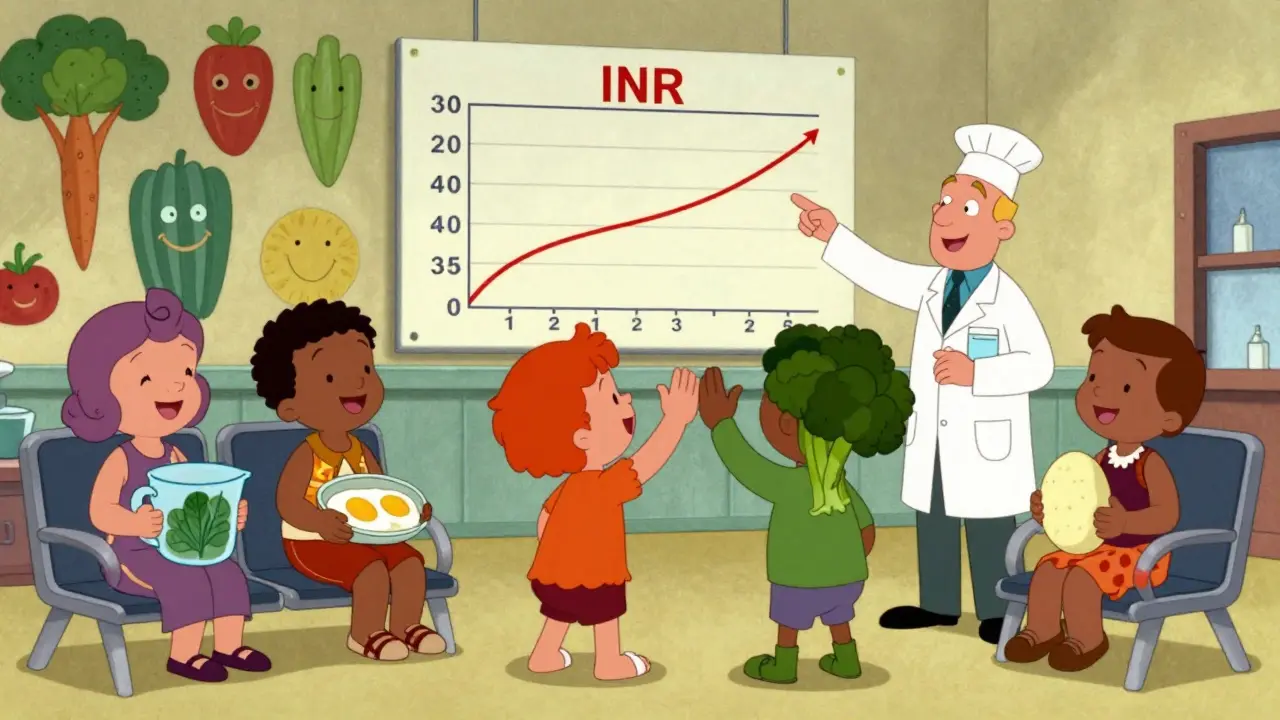
Your Daily Plan: Simple, Practical, Doable
Here’s what a week might look like:- Monday: ½ cup cooked broccoli (110 µg) + 1 egg (20 µg)
- Tuesday: 1 cup raw spinach (547 µg) - but only if you had none the day before
- Wednesday: ½ cup green peas (20 µg) + 1 cup milk (1 µg)
- Thursday: 1 cup raw kale (547 µg) - skip if you had spinach on Tuesday
- Friday: 1 egg (20 µg) + ½ cup cooked carrots (10 µg)
- Saturday: ½ cup cooked broccoli (110 µg)
- Sunday: Rest day - no greens, just normal meals
That’s not a diet. That’s a pattern. You’re not trying to eat the most vitamin K. You’re trying to eat the same amount. Your body learns the rhythm. Your INR stabilizes.
Most people find that after 4-6 weeks, they don’t need to measure anymore. Their body knows. Their plate knows. Their INR knows.
What If You’re Still Struggling?
If your INR keeps drifting even with consistent eating:- Check for hidden sources: soy sauce, fish oil, multivitamins, herbal teas
- Review all supplements-even “natural” ones can interfere
- Ask for a pharmacy consult: anticoagulation pharmacists specialize in this
- Ask about genetic testing if you’re a long-term patient with unstable INRs
And if you’re ever unsure-call your clinic. Don’t wait. Don’t guess. Your INR test is only once a month. Your plate is every day. Make it count.
Bottom Line: Eat the Same, Not Less
You don’t need to stop eating vegetables. You don’t need to live on white rice and chicken. You just need to eat the same amount of vitamin K, every day.That’s it. That’s the whole secret. No magic pills. No extreme diets. Just consistency. And that’s something you can control-every single day.
Stable INR means fewer blood tests. Fewer doctor visits. Fewer hospital stays. And most of all-peace of mind.