When someone loses a limb, their brain doesn’t immediately get the memo. Even though the arm or leg is gone, the nerves that once sent signals from it are still firing. And sometimes, those signals get misinterpreted as pain. This isn’t in their head-it’s in their brain. Phantom limb pain (PLP) affects 60% to 85% of amputees in the U.S., and for many, it’s not just a nuisance-it’s a constant, burning, stabbing, or cramping sensation in a limb that no longer exists.
Why Phantom Limb Pain Happens
It used to be thought that phantom pain was all in the mind, a kind of grief response. But brain scans tell a different story. When someone with PLP feels pain in their missing foot, the part of the brain that used to receive signals from that foot lights up. It’s not imagining the pain-it’s feeling it. The brain rewires itself after amputation. Nerves at the stump send out signals, and nearby areas of the brain-like those controlling the face or torso-start taking over the unused space. When you touch your cheek, for example, your brain might misread that as a signal coming from your missing hand. That’s called cortical remapping.Not everyone gets PLP, but certain things raise the risk: if you had chronic pain in the limb before surgery, if the amputation was due to a tumor, or if you had severe pain on the day of surgery. Triggers after surgery are common too-stress, cold weather, pressure on the stump, a poorly fitted prosthetic, or even an infection can make the pain flare up.
Medications: What Actually Helps
Most people start with meds because they’re fast and easy to access. But not all drugs work the same way, and side effects can be rough.Tricyclic antidepressants like amitriptyline and nortriptyline are the most commonly prescribed. They’re not for depression here-they work on nerve pain. Doctors usually start with 10 mg at bedtime and slowly increase to 50-75 mg. About 45% of users report moderate relief, but 60% say they feel drowsy or dry-mouthed. It’s a trade-off.
Anticonvulsants like gabapentin and pregabalin were originally made for seizures, but they calm overactive nerves. Gabapentin starts at 300 mg a day and can go up to 3,600 mg. In Reddit’s r/amputee community, 72% of users found it helpful, but 58% quit because of dizziness or brain fog. Pregabalin works faster but can cause weight gain-40% of users report that.
NSAIDs like ibuprofen or naproxen help a little at first-65% of patients feel some relief-but after three to six months, 80% say it stops working. They’re good for mild flare-ups, not the deep, constant pain.
Ketamine, given through an IV, is used when everything else fails. It blocks NMDA receptors, which are involved in pain memory. Doses are low-0.1 to 0.5 mg per kg-and it’s only done in clinics. Some patients get 50-70% pain reduction, but side effects like hallucinations and high blood pressure make it risky for long-term use.
Opioids like oxycodone or morphine are still used, but they’re controversial. The American Pain Society recommends staying under 50 morphine milligram equivalents (MME) per day. Why? Because 35% of long-term users develop dependence. They’re a last resort for severe, uncontrolled pain.
Botulinum toxin (Botox) injections into the stump can help if neuromas (tangled nerve endings) are causing pain. One 2023 case study showed pain dropping from 8/10 to 3/10 for 12 weeks. It’s not widely known, but it’s gaining traction in pain clinics.
Mirror Therapy: Seeing Is Believing
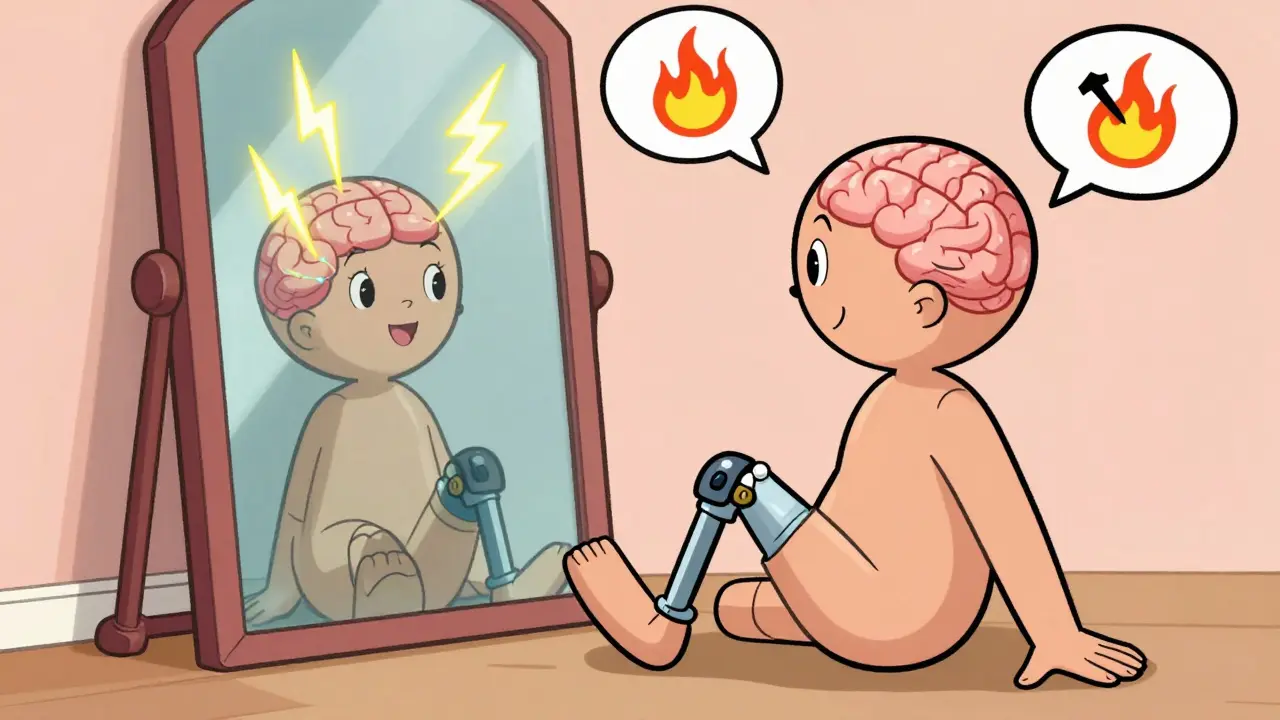
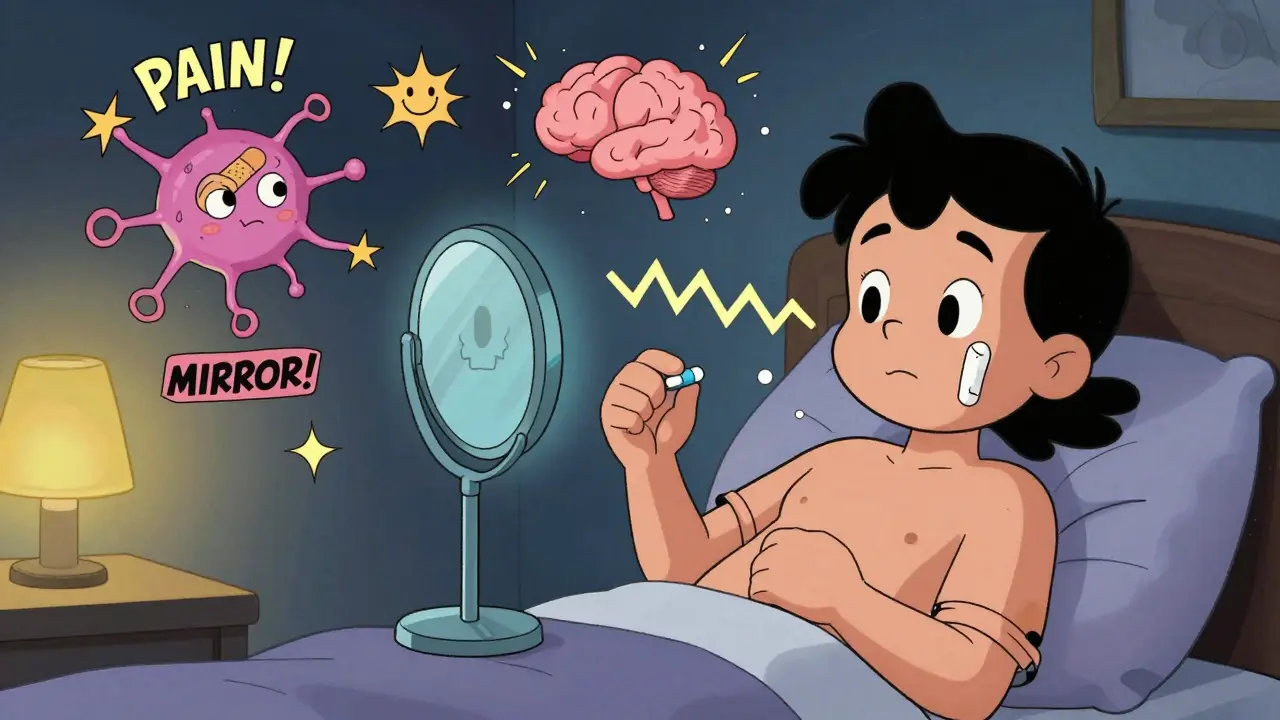
Mirror therapy is one of the most fascinating treatments-and it costs almost nothing. You sit in front of a mirror, place your intact limb in front of the mirror, and your stump behind it. The mirror reflects the good limb, making it look like the missing one is still there. Then you move both limbs-your real one and the one you see in the mirror.It sounds silly. But your brain sees movement where it expects movement. Over time, it starts to unlearn the pain signal. Studies show that 70% of patients who stick with it for four to six weeks see a 30-50% drop in pain. The catch? You have to do it every day, 15 to 30 minutes. And 40% of people quit within eight weeks because it’s boring or frustrating.
Dr. V.S. Ramachandran, who pioneered this method in the 1990s, believed the brain needed visual feedback to correct its false pain map. Today, virtual reality is being tested to make mirror therapy more immersive-imagine seeing a 3D animated leg move as you move your real one. Early trials suggest adherence could jump from 60% to 85% by 2027.
Other Non-Medication Options
If pills and mirrors aren’t enough, there are more advanced tools:- TENS units send small electric pulses through pads on the stump. About 30-50% of users get relief, but you need proper training. Placement matters-putting electrodes too close to the nerve ends can make it worse.
- Spinal cord stimulation involves implanting a device that zaps the spinal cord with mild electricity. It’s for severe, long-term cases. New FDA-approved devices like Saluda Medical’s Evoke (approved Jan 2024) use real-time feedback to adjust the signal, giving 65% average pain reduction.
- Biofeedback teaches you to control your body’s stress responses. With sensors on your skin, you learn to relax muscles and lower heart rate. It helps about 25-40% of users, especially when stress triggers their pain.
- Targeted muscle reinnervation is a surgical option. Surgeons reroute nerves from the amputated limb to other muscles. Combined with osseointegration (a metal implant in the bone), some patients report 70% pain reduction. It’s not widely available, but it’s growing in major medical centers.

What Doesn’t Work-and What’s Coming
Epidural anesthesia during amputation was once thought to prevent PLP. But recent reviews show it doesn’t make a difference. And while some swear by acupuncture or herbal supplements, there’s no solid evidence they work.What’s next? The field is moving fast. New NMDA receptor modulators are in Phase II trials-designed to give ketamine’s pain relief without the hallucinations. By 2030, experts predict a 40% drop in chronic PLP cases because of early, combined treatment. The goal isn’t just to numb pain-it’s to retrain the brain.
How to Start Treatment
There’s no one-size-fits-all. But here’s what works in practice:- Start low with amitriptyline (10 mg at night) or gabapentin (300 mg daily).
- Try mirror therapy daily for at least four weeks-even if it feels weird.
- Track your pain on a scale of 1-10 each day. Note triggers: weather, stress, prosthetic fit.
- If meds cause side effects, don’t quit. Talk to your doctor about switching or adjusting.
- Seek out a pain clinic with a multidisciplinary team. Many major hospitals now offer specialized PLP programs.
The key is persistence. Pain that lasts more than six months has a slim-to-none chance of going away on its own. But with the right mix of meds, movement, and mind training, most people can get back to living-not just surviving.
Is phantom limb pain real or just in my head?
It’s real-and it’s neurological. Brain scans show activity in areas that once controlled the missing limb. It’s not psychological; it’s the brain misreading signals after nerve damage and rewiring.
How long does it take for mirror therapy to work?
Most people start seeing results after 2-4 weeks of daily 15-30 minute sessions. But it takes at least six weeks to rewire the brain enough for lasting relief. Consistency matters more than intensity.
Can I use gabapentin and mirror therapy together?
Yes, and many doctors recommend it. Gabapentin reduces nerve fire, while mirror therapy retrains the brain. Together, they often work better than either alone. One 2023 study showed 68% of patients had better pain control with the combo than with meds only.
Why do some people get phantom pain and others don’t?
It’s not fully understood, but risk factors include pre-amputation pain, tumor-related amputations, and intense pain during surgery. People with better pain control before and after surgery are less likely to develop chronic PLP. Nerve damage severity and how the brain rewires also play a role.
Are opioids safe for long-term phantom pain?
Not recommended. While they can help in the short term, long-term use leads to dependence in about 35% of users. The American Pain Society advises staying under 50 morphine milligram equivalents (MME) per day. Safer alternatives like gabapentin, mirror therapy, or spinal stimulation are preferred for lasting relief.
What should I do if my pain gets worse after getting a new prosthetic?
Ill-fitting prosthetics are a common trigger. See your prosthetist immediately-pressure points or misalignment can irritate nerves. Also, check for skin breakdown or infection. If pain continues, talk to your pain specialist. You may need a different socket, padding, or nerve-targeted treatment like Botox.