When your doctor prescribes a medication, you might expect to get the name you recognize from TV ads or the pharmacy shelf. But more often than not, you’ll walk out with a different-looking pill - one with a simpler name and a much lower price tag. That’s a generic drug. And if you’ve ever wondered whether switching from a brand-name medication to its generic version is safe, effective, or even worth it, you’re not alone. The short answer? For most people, it’s completely fine - and often better. But there are important details you need to know before you make the switch.
What Exactly Is a Generic Drug?
A generic drug isn’t a copycat or a knockoff. It’s the exact same medicine, legally required to have the same active ingredient, strength, dosage form, and way of working in your body as the brand-name version. The FDA doesn’t allow a generic to be sold unless it proves it delivers the same amount of medicine into your bloodstream at the same speed as the original. That’s called bioequivalence. And the standard? The drug must perform within 80% to 125% of the brand’s results. In practice, most generics land within 4% of the brand’s performance, according to Harvard Medical School’s analysis of FDA data.That means if you take a generic version of high blood pressure medication, diabetes drug, or antidepressant, your body will respond the same way. The difference? Cost. Brand-name drugs can cost $300, $500, or even more per prescription. Generics? Often $15 to $40. The average patient saves $378 per prescription each year by switching, according to CMS data. That’s not a small amount - especially when you’re taking a medication every day for years.
Why Do Generics Look Different?
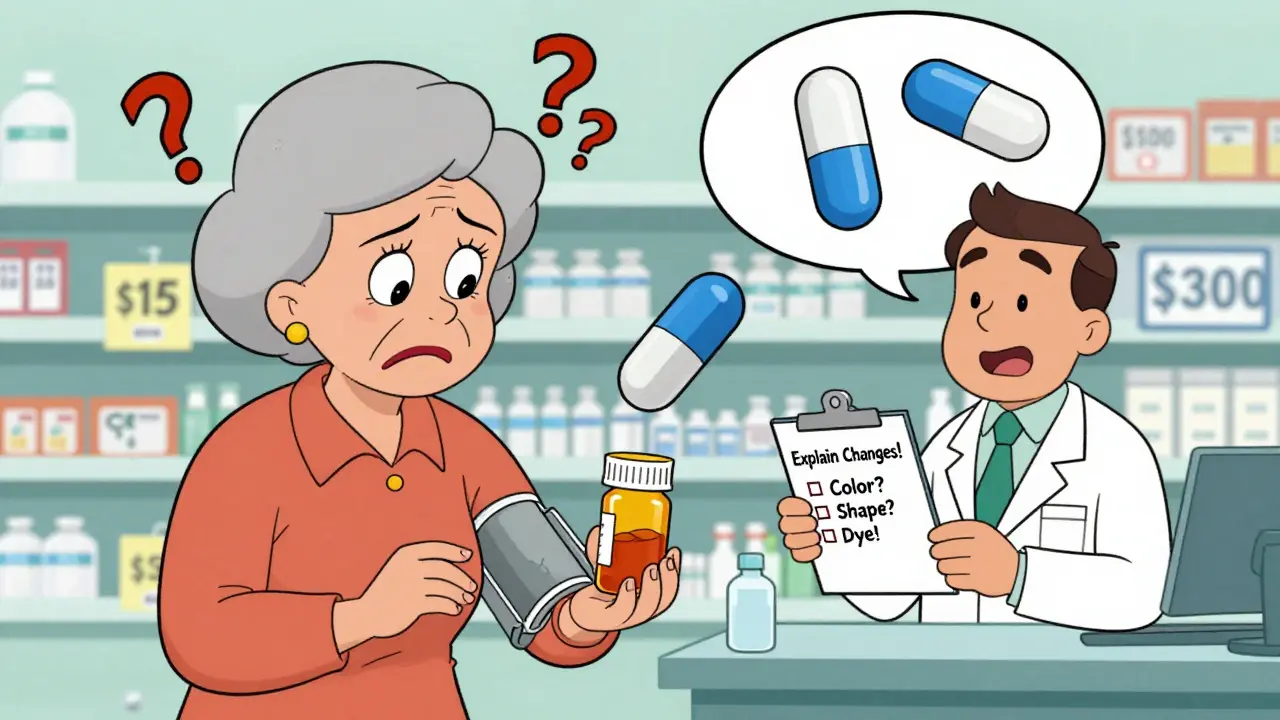
You might notice your new pill is a different color, shape, or size. That’s not a mistake. It’s the law. Trademark rules require generic manufacturers to make their pills look different from the brand-name version. You can’t have a generic version of Viagra that looks exactly like the real thing - even if it works the same. So manufacturers change the color, shape, or even the imprint on the pill.That’s fine for most people. But for older adults, people with memory issues, or those taking multiple medications, a change in appearance can be confusing. One case from the Patient Safety Reporting System involved an 82-year-old woman who accidentally took two pills because her blood pressure medication changed from a white oval to a blue capsule. She thought she hadn’t taken her dose. This is why pharmacists are required to explain the change when they substitute a generic. It’s not just about cost - it’s about safety.
When Generics Work Just as Well
The science is clear: for the vast majority of medications, generics perform identically to brand-name drugs. A major 2019 study in JAMA Internal Medicine reviewed over 2,000 clinical trials and found that generics matched brand-name drugs in effectiveness in 88% of cases. For conditions like high cholesterol, high blood pressure, diabetes, and depression, there’s virtually no difference in outcomes.Take metformin, the most common diabetes drug. A study by Kaiser Permanente showed that patients on generic metformin were 78% more likely to stick with their treatment than those on the brand-name version, Glucophage. Why? Because the generic cost $10 a month instead of $200. When medication is affordable, people take it. And that’s half the battle in managing chronic illness.
Same goes for heart medications. A 2022 study of 1.2 million patients by Northwestern University found no difference in heart attacks, hospitalizations, or deaths between those taking generic statins or beta-blockers versus brand-name versions. The drugs worked the same. The savings were huge. And adherence? Much better.
When You Should Be Cautious
Not all drugs are created equal - especially when it comes to how tightly your body needs to control the dose. These are called narrow therapeutic index (NTI) drugs. Small changes in how much medicine gets into your bloodstream can lead to big problems - too little, and the drug doesn’t work. Too much, and you risk serious side effects.The FDA specifically warns about a few key NTI drugs:
- Levothyroxine (for thyroid disease)
- Warfarin (a blood thinner)
- Phenytoin and carbamazepine (for seizures)
For these, consistency matters. The American Epilepsy Society found that 12.7% of patients who switched between different generic versions of seizure meds had breakthrough seizures. That’s three times higher than those who stayed on the same formulation. Some patients do better on one manufacturer’s generic than another. That’s why neurologists often recommend sticking with the same generic brand once you’ve found one that works.
Another area where generics can be tricky? Complex delivery systems. Inhalers, patches, and topical creams rely on how the drug is delivered - not just what’s in it. In 2020, the FDA issued a warning about generic versions of Advair Diskus, a common asthma inhaler. Some generics didn’t release the powder the same way, leading to inconsistent dosing. The same goes for some topical pain creams or hormone patches. If your medication is delivered this way, ask your pharmacist if a generic is truly equivalent.
What You Should Do When Switching
Switching to a generic isn’t something you just accept without thinking. Here’s what to do:- Ask your pharmacist - when they give you a new pill, ask: "Is this a generic? What’s the brand name? What’s different?" They’re required to explain it.
- Check the label - look at the inactive ingredients. Some generics use dyes, gluten, or lactose. If you’re allergic, this matters. The FDA requires this info, but not all labels make it easy to find.
- Monitor for changes - for two weeks after switching, pay attention. Are you feeling different? Any new side effects? Changes in energy, mood, sleep, or symptoms? Keep a simple log.
- Track key numbers - if you’re on diabetes meds, check your fasting glucose. If you’re on warfarin, monitor your INR. If you’re on antidepressants, use a mood tracker like PHQ-9. A change of 20 mg/dL in blood sugar or 0.5 in INR could mean something.
- Report problems - if you think the generic isn’t working, tell your doctor. You can also report it to the FDA at 1-800-FDA-1088. Your feedback helps improve safety.
What’s Changing in 2026?
The rules are getting better. Starting in 2024, Medicare will cover all FDA-approved generics without prior authorization - meaning no more delays or paperwork. By 2025, the FDA will require clearer labeling of inactive ingredients on all generic packaging. That’s huge for people with allergies.More complex generics are coming too. In January 2024, the first biosimilars for Humira (adalimumab) hit the U.S. market. These aren’t traditional generics - they’re made from living cells, not chemicals - but they work similarly and cost 15-30% less. Expect more of these in the next few years.
And the trend is clear: generics are taking over. As of 2023, 90% of all prescriptions filled in the U.S. were generics. That number is expected to hit 95% by 2030. The reason? Cost. And the system is designed to make generics the default - unless there’s a medical reason not to.
Real Stories, Real Savings
Maria Rodriguez from Phoenix switched from a $350-a-month brand-name cholesterol drug to a $15 generic. "I was skipping doses because I couldn’t afford it," she told ABC15. "Now I take it every day. My numbers are better than before."On Reddit, 83% of 347 people who shared their experience said they noticed no difference after switching. But 17% had issues - mostly confusion over pill appearance, or minor side effects like headaches or nausea that went away after a few days. One user wrote: "I thought my generic Zoloft wasn’t working. Then I realized I’d been taking it wrong because the pill looked different. Once I got used to it, I felt the same as before."
These aren’t outliers. They’re the norm. Most people do fine. But the ones who struggle? They’re often the ones who weren’t told what to expect.
Bottom Line
Switching from a brand-name drug to a generic is safe, effective, and smart - for almost everyone. You’ll save hundreds a year. You’ll be more likely to take your medicine. And your body won’t know the difference.But if you’re on a drug for thyroid disease, seizures, or blood thinning - or if you use an inhaler, patch, or cream - talk to your doctor before switching. Don’t assume all generics are the same. Ask about the manufacturer. Keep track of how you feel. And never be afraid to speak up if something feels off.
Generics aren’t a compromise. They’re the standard. And in 2026, they’re more reliable than ever.
Are generic drugs as effective as brand-name drugs?
Yes, for most medications, generics are just as effective. The FDA requires them to have the same active ingredient, strength, and how they work in the body. Studies show they match brand-name drugs in effectiveness 88% of the time. The main difference is cost - generics typically cost 80%-85% less.
Why do generic pills look different?
Trademark laws require generic drugs to look different from the brand-name version. That means different colors, shapes, or sizes. This helps avoid confusion and protects the brand’s identity. But it doesn’t affect how the drug works - only how it looks.
Can switching to a generic cause side effects?
Rarely. Side effects are usually caused by differences in inactive ingredients - like dyes, fillers, or preservatives - not the active drug. If you have allergies to certain substances (like lactose or food dyes), check the label. Some people report mild issues like headaches or nausea at first, but these often go away after a few days as the body adjusts.
Which drugs should I not switch to generic?
Avoid switching without talking to your doctor if you’re taking drugs with a narrow therapeutic index - like levothyroxine, warfarin, phenytoin, or carbamazepine. Small changes in blood levels can be dangerous. Also, be cautious with inhalers, patches, or topical creams, where delivery matters more than just the ingredient.
How do I know if my generic is working?
Monitor your symptoms and key health numbers. For diabetes, track fasting blood sugar. For blood thinners, check INR levels. For depression or anxiety, use a simple mood tracker. If you notice major changes - like worse symptoms, new side effects, or lab values shifting - contact your doctor. Keep a log for the first two weeks after switching.