
Dosing Tool Selector & Safety Checker
Find the Right Measuring Tool
Safety Verification Checklist
Getting a medication dose wrong isn't just a minor slip-up; it's a serious safety risk. Whether you're a parent trying to give a toddler the right amount of cough syrup or a caregiver helping an elderly relative, the stress of "eyeballing" a measurement can be overwhelming. In the US alone, the Institute of Medicine has noted that medication errors contribute to at least 1.5 million preventable adverse drug events every year. This is where visual dosing aids is specialized tools designed to improve medication administration accuracy through visual cues, markings, and measurement systems come into play. By removing the guesswork and complex math from the process, these tools act as a critical safety net for patients and providers alike.
Why Traditional Measuring Tools Often Fail
Most of us have used a kitchen spoon to measure liquid medicine, but that's a dangerous gamble. Household spoons vary wildly in size, meaning you could easily give too much or too little of a drug. Even standard medical tools can be confusing if the markings are too small or the scale is cluttered. When you're in a rush-or worse, in a high-stress emergency-your brain can struggle to process these small numbers, leading to what professionals call cognitive load. This mental fatigue is where most dosing errors happen.
Visual aids change the game by simplifying the interface. Instead of forcing you to calculate a dose based on a child's fluctuating weight or a complex concentration, they use colors, enlarged numbers, and clear boundaries. For example, in pediatric antiretroviral treatment, researchers like Callens et al. developed specific aids to help providers adjust doses as children grow, bypassing the complex math that often leads to mistakes in resource-limited clinics.
Common Types of Visual Dosing Aids and Their Uses
Not all measuring tools are created equal. Depending on the medication's viscosity and the required precision, you'll encounter different types of aids. Each one is designed to solve a specific problem related to accuracy.
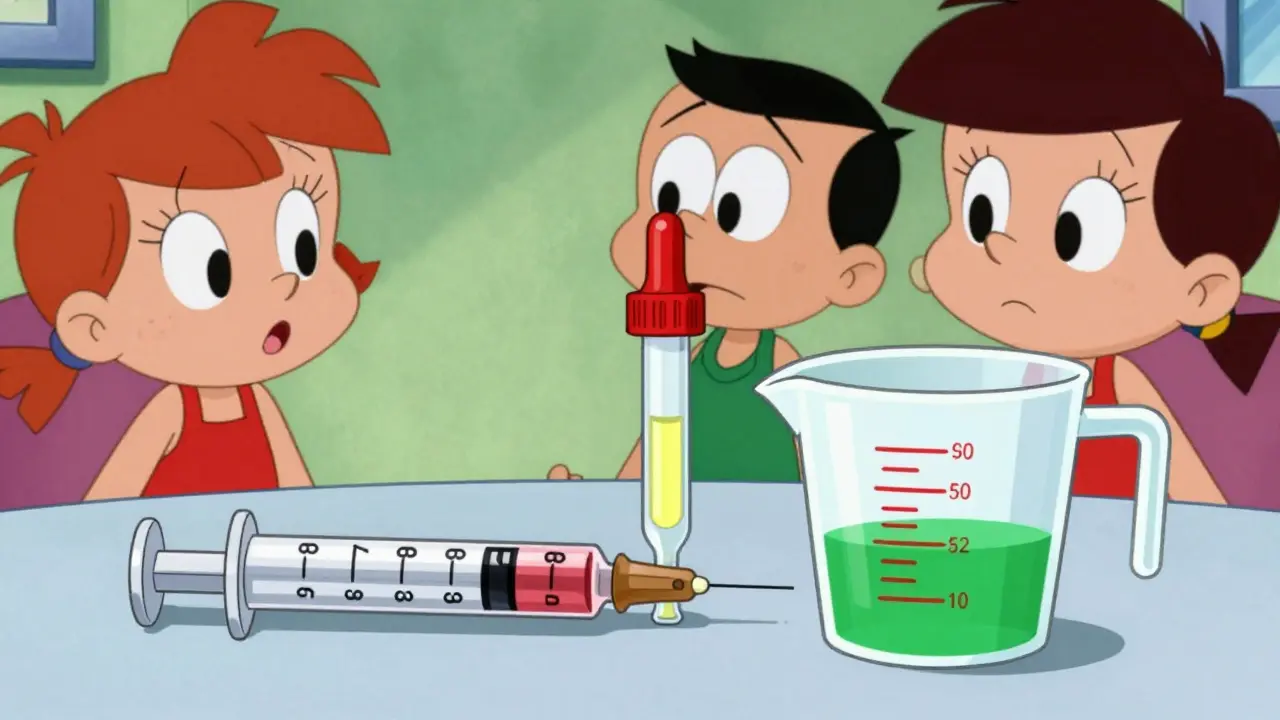
- Oral Syringes: These are the gold standard for liquid medication. Visual versions often feature high-contrast graduations and enlarged numbering. They eliminate the "dead space" errors common in household spoons and allow for precise delivery directly into the mouth.
- Medicine Droppers: Best for very small volumes. Modern visual droppers may include a window or a color indicator that signals when the correct volume has been drawn, preventing the "one extra drop" mistake.
- Graduated Measuring Cups: These are usually used for larger volumes of liquid. Visual aids here include "safe zones" marked in different colors to indicate the correct dosage range for specific patient weights.
- Visual Administration Charts: While not a physical tool you hold, these posters or cards translate weights and concentrations into a simple visual guide, telling the user exactly which mark on the syringe to fill to.
| Feature | Standard Tools | Visual Dosing Aids |
|---|---|---|
| Error Rate | Higher (est. 40% in some simulations) | Lower (est. 18.2% in some simulations) |
| Admin Speed | Slower (higher cognitive load) | Faster (approx. 36% improvement) |
| Confidence | Low/Uncertain | High (subjective user confidence) |
| Complexity | Requires manual calculation | Direct visual measurement |
The Real-World Impact: Speed and Accuracy
Does a few extra lines or a different color actually make a difference? The data says yes. A study by Gardner et al. (2018) looked at how radiologists handled contrast medium reactions-a high-pressure emergency scenario. They found that groups using visual aids were significantly faster and more accurate when administering epinephrine . Specifically, the time to administer the drug dropped from 152 seconds to just 97 seconds.
But it's not just about speed. The error rate plummeted from 40% to 18.2%. While a 18% error rate shows that these tools aren't magic and still require training, a 54.5% relative reduction in mistakes is a massive win for patient safety. The participants in the study reported feeling much more confident about the dose and the route of administration, proving that when you remove the mental math, you reduce the panic.
How to Incorporate These Tools Into Your Safety Plan
If you are managing chronic illness or caring for a child, these tools should be a core part of your home safety plan. Here is how to do it right:
- Match the tool to the medication: Don't use a dropper for a dose that requires 5ml; use a syringe. Don't use a cup for 0.5ml. Use the smallest tool that can comfortably hold the full dose.
- Verify the markings: Check if your syringe is marked in milliliters (ml) or cubic centimeters (cc). While they are usually the same (1ml = 1cc), consistency is key to avoid confusion.
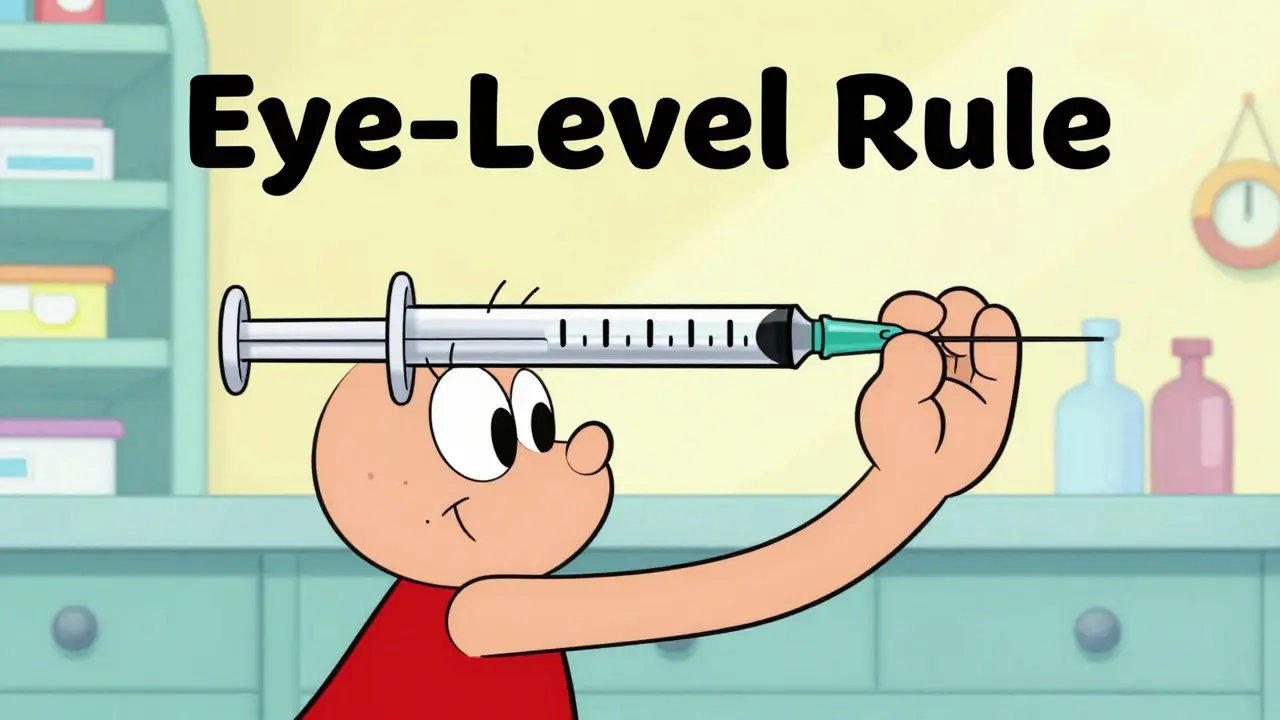
- Use the "Eye-Level" Rule: Always check the measurement at eye level. Looking from above or below can cause a parallax error, where the liquid appears to be at a different line than it actually is.
- Double-Check the Concentration: A visual aid tells you *how much* volume to draw, but you must ensure the concentration (e.g., 10mg/ml) matches the prescription.
Common Pitfalls and How to Avoid Them
Even with the best tools, mistakes happen. The Gardner study highlighted a persistent issue: self-administration errors. Even when a visual guide was present, some people still struggled with the actual physical act of injecting the medication. This tells us that a tool is only as good as the technique used with it.
Another common pitfall is "tool drift," where users start relying on a tool they think is accurate but isn't. For instance, using a syringe from a different medication's packaging. Always use the dosing device that came with the specific medication, as manufacturers often calibrate their visual aids to the exact viscosity of that drug.
Do visual dosing aids completely eliminate medication errors?
No, they don't. While they significantly reduce errors-sometimes by over 50%-some mistakes still occur. For example, in a simulation study of epinephrine administration, an 18.2% error rate remained even with visual aids. They should be used as part of a broader safety strategy that includes proper training and double-checking.
Can I use a kitchen spoon if I don't have a dosing syringe?
You should avoid this. Household spoons are not standardized and vary greatly in volume. This can lead to significant under-dosing or over-dosing. Always use a graduated medical tool like a syringe or a calibrated dosing cup.
Why are visual aids especially important for children?
Children's doses are often based on their weight, which changes as they grow. This requires frequent recalculations. Visual dosing aids simplify these weight-band calculations, reducing the risk of a provider or parent making a math error during a dose adjustment.
What is the difference between a dropper and a syringe for dosing?
Syringes are generally more accurate for precise volumes and are better for administering medicine to those who cannot swallow easily. Droppers are typically used for smaller, drop-by-drop doses, though they can be less precise if the liquid is too thick or the dropper isn't calibrated.
How do I know if my dosing tool is accurate?
The most reliable tools are those provided by the pharmaceutical manufacturer specifically for that medication. If you are using a generic tool, ensure it has clear, permanent graduations and is made of medical-grade plastic that doesn't warp.
Next Steps for Your Safety Plan
If you're currently managing medications at home, start by auditing your tools. Toss out any household spoons or improvised measuring devices. If you're unsure about the dose for a growing child, ask your pharmacist for a weight-based visual chart or a specific dosing syringe that matches the current prescription. For those in high-stress environments, practicing with simulation-based scenarios can help bridge the gap between having a tool and knowing how to use it instinctively under pressure.